By Faith Abel Offered a Better Sacrifice Than Cain

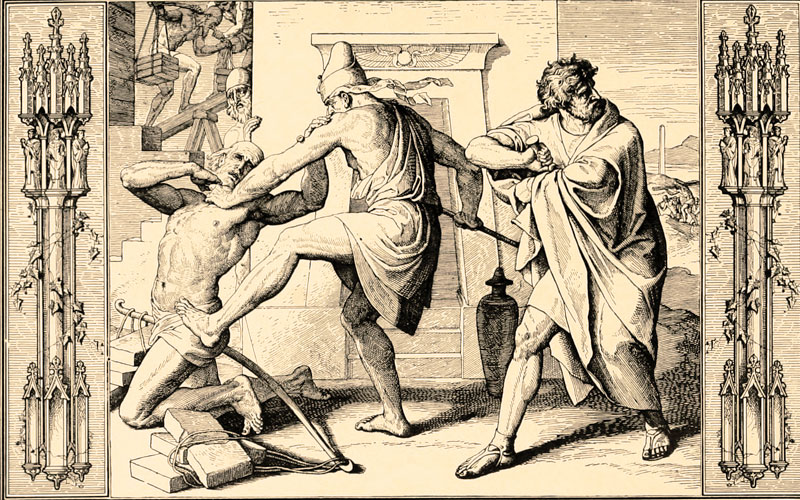
Cain and Abel

Hebrews 11 contains many examples of faith. The first individual mentioned is Abel. His faith was demonstrated through the sacrifice he offered to God.

By faith Abel offered to God a better sacrifice than Cain, through which he obtained the testimony that he was righteous, God testifying about his gifts, and through faith, though he is dead, he still speaks” (Hebrews 11:4).

In Genesis 4, we read of the sacrifices of these two brothers.

So it came about in the course of time that Cain brought an offering to the Lord of the fruit of the ground. Abel, on his part also brought of the firstlings of his flock and of their fat portions. And the Lord had regard for Abel and for his offering; but for Cain and for his offering He had no regard. So Cain became very angry and his countenance fell” (Genesis 4:3-5).

Why did God accept Abel’s offering but not Cain’s? We are not told in Genesis, but we were told in Hebrews 11:4. Abel’s offering was accepted because it was offered “by faith.
Continue Reading

Making the Most of Your Time

Pocket Watch

Each one of us is busy with obligations and responsibilities that have been placed upon us and that we have taken upon ourselves. Our lives can be hectic and we sometimes wonder how we will ever have time to do what we need to do. This is just as much of a challenge for Christians as it is for anyone else.

Paul provided some instructions about time management that would be good for us to heed:

Therefore be careful how you walk, not as unwise men but as wise, making the most of your time, because the days are evil” (Ephesians 5:15-16).

Continue Reading

“Let the Women Keep Silent in the Churches”

Bible Reading

[This article was written by Tim Haile.]

For centuries, questions and controversies have existed among religious people over the role of women in the work and worship of the local church. Two extreme positions have arisen:

  1. Some have concluded that the Bible authorizes women to preach and hold positions of authority within the local church. I am regularly asked what I believe about “women preachers.” History reveals that the women-preacher movement is closely connected to the overall and more secular women’s liberation movement.
  2. To the opposite extreme, some have concluded that the Bible doesn’t authorize women to speak at all in church assemblies, even going so far as to prohibit women from participating in singing.

These extreme positions result from people either completely rejecting the plain commands of Scripture, or from a failure to consider their context.
Continue Reading

The Three Things Jesus Accomplished in His Death

Cross

Toward the end of a lengthy discussion of Jesus’ work as our high priest, the Hebrew writer provided a summary in his explanation of Psalm 40:6-8. In this explanation, he spoke of the three things Jesus came to the earth to accomplish.
Continue Reading

Is the Church of Christ a Denomination?

Church of Christ

This question will come up from time to time as we interact with those around us. To many, churches of Christ (labeled by some as “Church of Christ”) are just one denomination among many. This perception can lead them to view the members of churches of Christ as hypocrites – condemning denominationalism while (allegedly) being part of one.

Is the church of Christ a denomination? It is a fair question. Depending on what one has in mind, there could be various answers given – yes, no, maybe, not yet, etc. So let us consider the question about the church and denominationalism.
Continue Reading

Quibbles About Baptism

Quibbles About Baptism

One of the major distinctions between brethren and the religious world relates to how we understand baptism. We teach that baptism is necessary for salvation (Mark 16:16; 1 Peter 3:21), is for the remission of sins (Acts 2:38; 22:16), and is our entrance into the Lord’s kingdom (Acts 2:41, 47; 1 Corinthians 12:13). Many others teach that baptism is an outward sign of an inward grace (that we are saved before and without baptism) and that it is for membership in a local church or denominational body.

Of course, there are no passages in the New Testament that teach baptism is an outward sign of an inward grace or that we are baptized to gain membership into a local church (and certainly not into a denomination since the New Testament does not speak about them at all). Instead of trying to twist passages in order to provide positive support for these ideas, denominationalists will generally will try to make arguments against the necessity of baptism. They quibble about various passages to try to attack the truth about baptism. Let us notice some passages that people try to use in arguing that baptism is not essential for salvation.
Continue Reading

Debt & Forgiveness

[This article was written by Robert A. Sochor.]

In Matthew 18:23-35, Jesus taught the parable of the unmerciful servant. For every generation it is relevant and helps us understand the need for forgiveness: forgiveness granted to the king’s servant as well as the forgiveness and mercy that were denied to the servant’s debtor. The king of verse 23 who ruled over all in the parable was displeased (wroth, verse 34) with his servant and actually ended his forbearance by requiring payment. The concluding lesson of the parable is found in verse 35 — that we as forgiven sinners should forgive those who trespass against us.

I have not done the parable justice by summarizing it so briefly. But there is one point of the parable that stands out, and that is the servant’s debt to the king. In verse 24 the servant had run up a debt of 10,000 talents. There are varying explanations of how much debt this actually was. One margin note stated that one talent was about 15 years’ wage for a common laborer. Multiplying this out would show this debt was quite unpayable. Other estimates I have heard run into the millions, even the billions, of dollars. I have always wondered, how did he run up such a debt? How did he ever expect to repay it? And what was he thinking?

But then I remember this is just a parable. A parable is a story to illustrate a greater spiritual truth. The man in the parable really does not exist. He is only in the story to represent someone else. And that someone is us. We are the ones who ran up a completely unpayable debt. We are the ones not thinking of how we would ever pay back the debt that we had run up. If we consider the man in the parable foolish, then we would have to say that also about ourselves. There is not one of us who could point to this man and say, “I’d never do that.” We have all sinned (Romans 3:23; Galatians 3:22). We have incurred that overwhelming debt we could never repay. And the debt we owe because of our sin is staggering. Romans 6:23 says the “wages” (the just compensation) for our sins is death. In the Old Testament, Ezekiel states the consequences more bluntly: “The soul that sins, it shall die” (Ezekiel 18:20). Sin carries a terrible consequence.

In the parable the foolish debt-ridden servant was fortunate to be in debt to this particular king for he was merciful. There is nothing about the servant which should recommend forgiving the debt. He was not particularly good; in fact, there is nothing good said about this servant in all of the parable. He had done nothing to merit this forgiveness.

After being forgiven, there was no change in the servant. Such forgiveness “reasonably” should have produced (or have been followed by) a change in character and conduct in his life. It did not. In the case of ourselves, when forgiven we should have a change of character and conduct. The New Testament calls this “newness of life” (Romans 6:4) or being “transformed” (Romans 12:2). The God who granted such great forgiveness has every reasonable expectation that this change would be present in those He has forgiven.

There is a practicality to this and probably all parables. If we miss it, it is to our shame.