What Would Jesus Do?

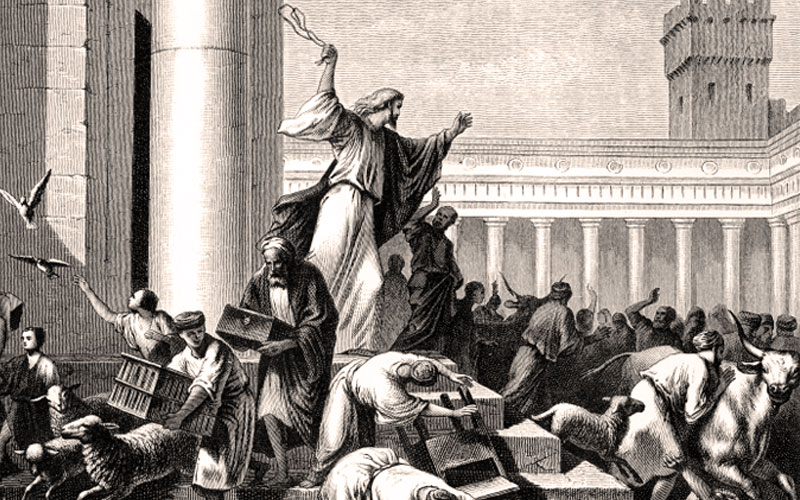
Jesus and the moneychangers

What would Jesus do? This is a question that many religious people ask themselves when they attempt to decide if a particular decision or activity is right. Their intentions might be good – trying to focus on Jesus and please Him. However, this question is the wrong question!

Why is this the wrong question? It is too subjective. It turns our responsibility into nothing more than what we think Jesus would do in a given situation. Instead of asking a subjective question like this (What would Jesus do?), let us consider some other questions to ask – questions for which we can find objective and definitive answers from the Scriptures.
Continue Reading

Hold Fast the Word

Open Bible

Hold fast the word.” This statement, or one similar to it, is found several times in the New Testament. The “word” to which we are to “hold fast” is the word of God. But why are we to hold fast to it? We can answer that question by examining the passages that contain this admonition. There are several reasons why we must continue to “hold fast the word.” Let us notice the reasons presented to us in the Scriptures.
Continue Reading

The Problem with Denominations

Church building

Simon Peter answered, ‘You are the Christ, the Son of the living God.’ And Jesus said to him, ‘Blessed are you, Simon Barjona, because flesh and blood did not reveal this to you, but My Father who is in heaven. I also say to you that you are Peter, and upon this rock I will build My church; and the gates of Hades will not overpower it’” (Matthew 16:16-18).

In the first century, there were no denominations – only the Lord’s church (Matthew 16:18). Paul said there is just “one body” (Ephesians 4:4), and that body is the church (Ephesians 1:22-23).

But today, unlike the first century, there are thousands of denominations. Is this a problem? Many will say “no.” They have been taught to “join the church of your choice” because “one church is as good as another.” But the Scriptures teach that this is a problem. Why? In this article we will notice four reasons why denominationalism is a problem.
Continue Reading

The Foundation for a Godly Society

Moses and the Ten CommandmentsThe Ten Commandments (Exodus 20:1-17) – the laws engraved onto stone which God delivered to Moses for the children of Israel – give us the blueprint for the foundation of any godly or righteous society. These Ten Commandments are regularly assaulted by those on the “left” as having no place in our government or our schools. The stated reason for their opposition is that the Ten Commandments represent a religious element that has no place in anything related to government. Yet the Ten Commandments represent more than just religion. The reason there is such strong opposition to the display of the Ten Commandments by the “left” is because the Ten Commandments stand in direct opposition to the Liberal’s ideal for society.


Many today view the Ten Commandments as part of the foundation of our religion. Yet they are part of the Old Law which was nailed to the cross (Colossians 2:14). Does this mean they are of no value for us today? Certainly not! But we must use them properly. The Old Testament was written and is preserved “for our instruction” (Romans 15:4). When we study the Ten Commandments, we find the foundations of a godly society.
Continue Reading

Bringing Up Children in the Lord (Part 6): Raising Children to Be Christians

Bringing Up Children in the Lord

I have no greater joy than this, to hear of my children walking in truth” (3 John 4).

Though the passage above refers to Christians in general, the principle certainly applies to the relationship between parents and children. As parents strive to “bring [their children] up in the discipline and instruction of the Lord” (Ephesians 6:4), the ultimate goal is to lead them to the Lord. Naturally, parents will hope that their children enjoy good health and a degree of prosperity in this life. But in the end, what matters most is that their “soul prospers” as they walk “in the truth” (3 John 2, 4). So in this final lesson, we will focus on raising children to be Christians.
Continue Reading

How Long Will You Hesitate Between Two Opinions?

Fork in the Road

Just before Elijah’s confrontation with the prophets of Baal on Mount Carmel, he issued a challenge to the people of Israel who had gathered to witness the event.

Elijah came near to all the people and said, ‘How long will you hesitate between two opinions? If the Lord is God, follow Him; but if Baal, follow him.’ But the people did not answer him a word” (1 Kings 18:21).

The people were presented with a choice between two options – follow God or follow Baal. Similarly, we have choices to make about our personal conduct and religion. Many people like to think that they have a multitude of options from which to choose. But when you break down every decision, there are really just two options – follow God or not.
Continue Reading

R.W. Officer: “Suppose I Have No Interpretation of the Bible on Any Subject”

R. W. Officer: No Interpretation

Robert Wallace Officer (1845-1930), at one point in his life, served as a missionary for the Liberty Baptist Association. During this six year period, he faced several charges of heresy. Below is an excerpt from a heresy trial in which Dr. J.R. Graves examined him to determine his “soundness of faith.”
Continue Reading