How Could a Loving God Send Anyone to Hell?

Many people struggle with the above question. We know that God, by His very nature, is love (1 John 4:8), and that hell is a place of eternal torments (Matthew 25:41, 46). How then could God condemn anyone to such a place? This does not fit with the concept many people have of a loving God. Therefore, many start to doubt the existence of hell or even the existence of God.

The Scriptures teach that God will send certain individuals to eternal punishment in hell. Not only that, but His doing so will not be inconsistent with His nature, but instead will be consistent with the way He is described in the Bible.
Continue Reading

God’s Killing of Children in Old Testament Judgments

King Saul received instructions from the Lord regarding the destruction of the Amalekites. “Now go and strike Amalek and utterly destroy all that he has, and do not spare him; but put to death both man and woman, child and infant, ox and sheep, camel and donkey” (1 Samuel 15:3).

This is not the only time we read of children being killed in the execution of divine judgment. The skeptic sees this as an opportunity to attack God, the Bible, and the faith of those who believe in God. Why would God kill, or instruct others to kill, infants and children?

Tim Haile has put together a good study on this question. If you have wondered how a just God could allow these children to be killed along with the wicked, or you want to better equip yourself to answer the skeptic on this point, I encourage you to read his material.

You can find the article at the following link: God’s Killing of Children in Old Testament Judgments (PDF)

The Value of the Old Testament

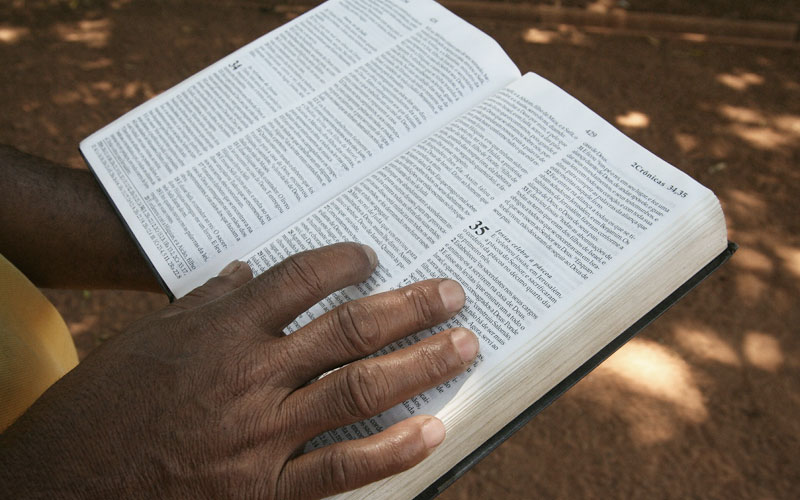
Bible reading

At the first of the year, I started a Bible reading plan that would take me through the Bible in one year. There are several different reading plans people use to read through the Bible. Some sort the books by chronological order. Others arrange the schedule so that one reads a portion of both the Old and New Testaments each day. The plan I followed this year went through the books of the Bible in the order they appear. I have been able to keep up with the schedule (though there were times I was playing catch-up) and am currently up to date with the readings.

On October 1, I finished the book of Malachi. That means it took just over nine months to finish the Old Testament.

This served as a simple reminder that we cannot ignore the Old Testament Scriptures. Yes, we are under a new law (Hebrews 8:8-10) and the old law was nailed to the cross (Colossians 2:14). But that does not mean the Old Testament is worthless to us today.
Continue Reading

“Hallelujah!” – A Call for Praise or a Thoughtless Exclamation?

Man at Sunrise

We are used to hearing and seeing the word hallelujah as we read the Bible, sing spiritual songs, and listen to teaching from the word of God. I have also noticed this word being used with increasing frequency as a mere exclamation that one utters when something good happens to them.

  • We found a parking space close to the door – Hallelujah!
  • Our electric bill was down this month – Hallelujah!
  • It’s five o’clock and time to clock out and go home – Hallelujah!

Is this how we ought to be using this word? Does it matter? Let us consider a few things from the Scriptures.
Continue Reading

Seeking God

Man at Night

When Paul was in Athens, a city full of idolatry, he found opportunity to teach them about the one true God. He was to them “an Unknown God” (Acts 17:23). God does not want to be unknown to His creation, but has instilled in us the desire to seek after Him. Paul explained this to the Athenians:

He made from one man every nation of mankind to live on all the face of the earth, having determined their appointed times and the boundaries of their habitation, that they would seek God, if perhaps they might grope for Him and find Him, though He is not far from each one of us” (Acts 17:26-27).

God wants us to seek for Him and He is not far off. But does this mean we can seek after God in whatever way we wish, doing what seems good to us and expecting that God will be pleased? There are many who think this way, but it is not what God wants from those who would seek after Him.
Continue Reading

Submit to God, Resist the Devil

Submit therefore to God. Resist the devil and he will flee from you” (James 4:7).

The two words James used to admonish Christians in their walk – submit and resist – both involve action. This should not be surprising. Earlier in the letter he commended an active faith while condemning a passive faith.

Regarding the active faith, James wrote, “Show me your faith without the works, and I will show you my faith by my works” (James 2:18). Further on he said, “You see that a man is justified by works and not by faith alone” (James 2:24).
Continue Reading

The Catholic Church’s Search for Aliens

Last week the Associated Press reported that the Vatican is looking for signs of alien life. They have called in thirty scientists from several countries to study “whether sentient life forms exist on other worlds.” If extraterrestrial life is possible, there is also the question about “its implications for the Catholic Church.”

The subject of aliens is an interesting topic to many people. But what, if any, bearing does it have on our faith or service to God. Regardless of whether extraterrestrial life is possible, or even if intelligent life forms do exist on other planets, there are some truths that we must remember. These will not change, no matter what is discovered by science (or the Catholic Church).
Continue Reading