Answering Basic Questions (Part 12): What Happens When We Die?

Answering Basic Questions

Death is a sad reality of life. Everyone understands this, whether they are religious or not. But what comes after death? Many wonder about this, but not everyone has an answer that satisfies their curiosity. However, if we look to the Bible, we can find the answer to this question.

What happens when we die? Let us notice four points.Continue Reading
An Unknown but Knowable God

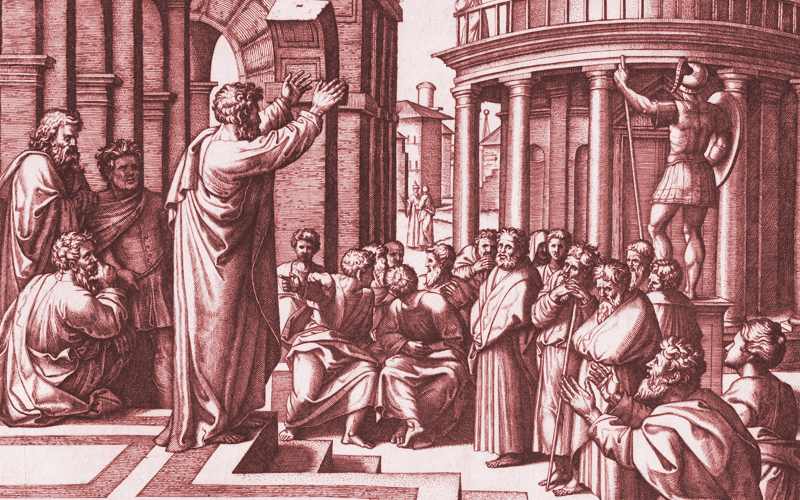
Paul preaching in Athens

When Paul was in Athens, Luke recorded that “his spirit was being provoked within him as he was observing the city full of idols” (Acts 17:16). This prompted him to teach “in the synagogue” and “in the market place every day with those who happened to be present” (Acts 17:17). His message piqued the interest of the philosophers who brought him to the Areopagus so they could hear more about the “strange things” (Acts 17:20) he was teaching.

Though the people of the city were “very religious” (Acts 17:22), the God of heaven was “unknown” (Acts 17:23) to them. So Paul proceeded to teach them about the one true God.

The God who made the world and all things in it, since He is Lord of heaven and earth, does not dwell in temples made with hands; nor is He served by human hands, as though He needed anything, since He Himself gives to all people life and breath and all things; and He made from one man every nation of mankind to live on all the face of the earth, having determined their appointed times and the boundaries of their habitation, that they would seek God, if perhaps they might grope for Him and find Him, though He is not far from each one of us; for in Him we live and move and exist, as even some of your own poets have said, ‘For we are His children.’ Being then the children of God, we ought not to think that the Divine Nature is like gold or silver or stone, an image formed by the art and thought of man” (Acts 17:24-29).

We encounter many today who are like the Athenians. They simply do not know God. How can we begin to teach them? Consider what Paul explained on this occasion to these pagan philosophers.Continue Reading

Answering Basic Questions (Part 5): What Is the Gospel?

Answering Basic Questions

We often talk about the importance of preaching the gospel. But what does that mean? The gospel is foundational to our faith. Therefore, if we are to be “ready to make a defense…for the hope that is in [us]” (1 Peter 3:15), then we ought to be able to concisely explain it to others.

So what is the gospel? Let us consider four points here.Continue Reading

Answering Basic Questions (Part 2): What Is the Bible?

Answering Basic QuestionsThe Bible is the most well-known and well-preserved book of all time – no other book of antiquity comes close to having the manuscript evidence that the Bible has. Believers in God recognize the Bible as His word and those who reject God still cannot ignore it. It is truly a unique book.

But what is the Bible? Let us consider four points that will help us begin to answer that question.Continue Reading

Love Perfected

Love

No one has seen God at any time; if we love one another, God abides in us, and His love is perfected in us” (1 John 4:12).

John spent much of his first epistle writing on the topic of love. One of the ideas he discussed was about love being perfected. To be perfected means to be completed, accomplished, or fulfilled (Strong’s).

What does perfect love look like? Let us notice four points made by John in his epistle.Continue Reading

Is Any Behavior Acceptable As Long As It Does Not Hurt Anyone Else? (04.21.22)

Subscribe: Apple Podcasts | Google Podcasts | Stitcher | Spotify | RSS

Plain Bible Teaching Podcast

This week’s episode is going to be a little bit different. Rather than talking about a specific news story or article, we’re going to be talking about a particular concept that is popular in our society today. It is the idea that we cannot be critical of or condemn someone’s behavior or lifestyle as long as they are “not hurting anyone.” This has been used for years to justify the use of drugs and things like that. More recently, it is used to defend homosexuality and transgenderism. If it can be proven that one’s behavior does not physically/mentally/emotionally/spiritually harm another person, does that mean the behavior is justified? We’re going to explore that question by considering some Biblical principles today.Continue Reading

Accountability to God and Our Psychological Well-Being (03.10.22)

Subscribe: Apple Podcasts | Google Podcasts | Stitcher | Spotify | RSS

Plain Bible Teaching Podcast

This week we’re going to be talking about the connection between one’s psychological well-being and the recognition of one’s accountability before God. People talk a lot about mental health these days. Though this may come as a surprise for some, knowing that we will one day stand before the Lord in judgment is actually good for our mental health. We’re going to consider this in our episode today.Continue Reading