The Chief of Sinners

Paul in prison

Because of his past, Paul would have seemed to be an unlikely candidate for salvation, let alone apostleship. In the following passage, he explained to Timothy why the Lord chose him and how he was able to be saved.

I thank Christ Jesus our Lord, who has strengthened me, because He considered me faithful, putting me into service, even though I was formerly a blasphemer and a persecutor and a violent aggressor. Yet I was shown mercy because I acted ignorantly in unbelief; and the grace of our Lord was more than abundant, with the faith and love which are found in Christ Jesus.

It is a trustworthy statement, deserving full acceptance, that Christ Jesus came into the world to save sinners, among whom I am foremost of all [of whom I am chief, KJV]. Yet for this reason I found mercy, so that in me as the foremost, Jesus Christ might demonstrate His perfect patience as an example for those who would believe in Him for eternal life” (1 Timothy 1:12-16).

Continue Reading

Are We Truly Disciples of Christ?

John 8:31

Many people claim to be disciples of Christ, but are they truly His disciples? Are we? This is a legitimate and important question. Notice what Jesus said:

So Jesus was saying to those Jews who had believed Him, ‘If you continue in My word, then you are truly disciples of Mine; and you will know the truth, and the truth will make you free’” (John 8:31-32).

When Jesus said, “then you are truly disciples of Mine,” He implied that some are not truly His disciples. So the question under consideration is vitally important: Are we truly disciples of Christ? We must be sure we can correctly answer this question for ourselves. We must also be prepared to try and help others to be able to correctly answer this question for themselves. The context of the above passage shows us what it means to be disciples of Christ.
Continue Reading

Does God Want Us to Be Happy?

Ohio Senator Rob PortmanOhio Senator Rob Portman wrote an editorial that was published on March 15, 2013 in which he announced his change of position on same-sex marriage. Previously, he had been against such “marriages.” Now he believes “the government shouldn’t deny [same-sex couples] the opportunity to get married.”

In the editorial, he explained the reason for his change of heart. Two years ago, one of his sons informed him that he was a homosexual. After learning this, Senator Portman began re-evaluating his stance on same-sex marriage and eventually changed his mind on the issue. He said he is “a dad who wants all three of his kids to lead happy, meaningful lives with the people they love.” Couple that with his statement about “the Bible’s overarching themes of love and compassion and my belief that we are all children of God,” and we see one who has tried to find a way to harmonize – in his own mind – faith in God and man’s desire to be happy.

His statement about wanting all of his children to be happy seems reasonable to a lot of people, even among those who are religious. Many people believe that God would want them to be happy. Therefore, if something like homosexuality makes one happy, they conclude that God must accept it and that we should accept it, too.

So we should ask the question: Does God want us to be happy? In answering this question, we must be sure that our conclusion comes from the Bible and not our emotions.
Continue Reading

“These Were More Noble-Minded”

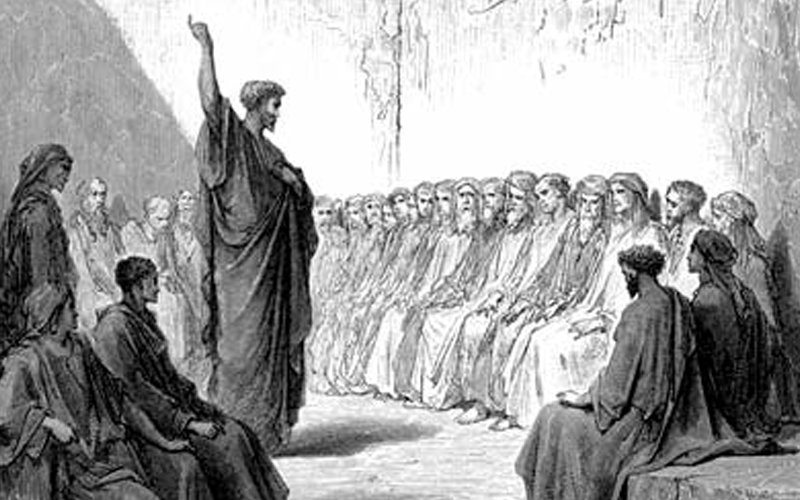
Paul preaching in Thessalonica

Paul was in Thessalonica for just three weeks when he had to quickly leave the city under the cover of darkness because of the uproar that was caused by his preaching (Acts 17:1-10). When he left, he went to Berea. Undeterred by his experience in Thessalonica, he preached in this new city as well. Luke noted the significant reaction of the Bereans:

Now these were more noble-minded than those in Thessalonica, for they received the word with great eagerness, examining the Scriptures daily to see whether these things were so” (Acts 17:11).

Luke compared the Thessalonians and the Bereans in their reaction to the gospel. The Bereans were “more noble-minded” in that they “received the word with great eagerness.” This does not mean that everyone in Thessalonica rejected the gospel – some were persuaded (Acts 17:4). This also does not mean that everyone in Berea accepted the gospel – the Jews of Thessalonica were able to come to Berea and turn “the crowds” against Paul (Acts 17:13). But there is an important difference between the first recipients of the gospel in each city – those in the synagogues (Acts 17:2, 10). Notice what Luke recorded about Paul’s custom in preaching.
Continue Reading

The Body, Bride, and Church of Christ

Jesus offers an invitation to all men: “Come to Me, all who are weary and heavy-laden, and I will give you rest” (Matthew 11:28). He is able to offer this rest because of His work in reconciling man and God through the cross (Ephesians 2:13-16). After we obey the gospel by putting on Christ in baptism (Romans 6:3, 17), we are to “walk in newness of life” (Romans 6:4).

What do we call those who have obeyed the gospel? Individually, we call them Christians (Acts 11:26; 26:28; 1 Peter 4:16). But what about the universal body of all those who have become Christians? There are a few different terms used in the New Testament. In this article we will consider three – the body, the bride, and the church of Christ.
Continue Reading

An Institution of Higher Education

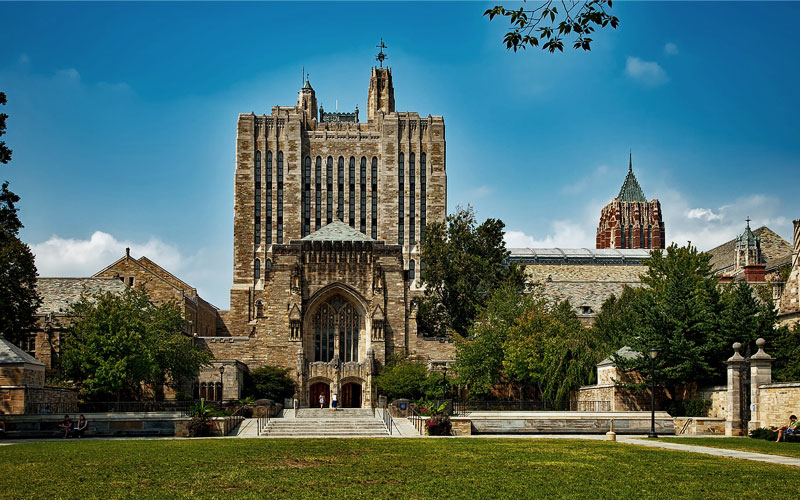
Yale University

In our society, a great deal of emphasis is placed upon obtaining a college education in order to prepare for secular employment. For many careers, this is helpful. For some, it is essential. Therefore, many people pursue a secular education in an institution of higher learning in order to best prepare themselves to find what they consider to be good jobs.

However, there is a type of education that is far more important than the education that prepares one for employment. This higher education is not for secular pursuits, but spiritual. It prepares us not for the work force (at least not directly), but for our service to God. Its purpose is not to help us obtain a high-paying job with good benefits, but to help us obtain eternal life.

Strangely, some act as though an institution devoted to secular education is also the preferred institution for their spiritual education. But God has created His own institution of higher education – the church. It has everything we need for the pursuit of a higher (i.e. from God) education. Let us notice what the Bible says about this institution of higher education.
Continue Reading

“Upon This Rock”

Mountain, Yosemite

Any structure must be built upon a solid foundation. A house built upon a rock will stand while one built upon the sand will fall (Matthew 7:24-27). The same principle applies to the church. Though many use the term “church” to refer to a physical building, it is not used this way in the New Testament. Instead, the church is a spiritual building rather than a physical one. Even so, the church, if it is to stand, needs a solid foundation.

In promising to build His church, Jesus told His disciples that it would have such a foundation.

Simon Peter answered, ‘You are the Christ, the Son of the living God.’ And Jesus said to him, ‘Blessed are you, Simon Barjona, because flesh and blood did not reveal this to you, but My Father who is in heaven. I also say to you that you are Peter, and upon this rock I will build My church; and the gates of Hades will not overpower it’” (Matthew 16:16-18).

Jesus said that His church would be built upon a rock. It would be so strong and secure that it would not even be overthrown by the gates of Hades. But what is the rock that would serve as the foundation?
Continue Reading