
Practical Ways for Developing a Better Understanding of God’s Word

Bible Study

At the start of the new year, many have made the determination to increase their knowledge and understanding of the Bible. This is certainly commendable. The Bible is the inspired word of God (2 Timothy 3:16). It contains the “words of eternal life” (John 6:68). The gospel is “the power of God for salvation” (Romans 1:16). No book is more deserving of our attention than the Bible.

It is one thing to want to grow in knowledge of the Bible. It is another to actually do it. So as we begin this new year, I want to consider some practical ways in which each one of us can develop a better understanding of the word of God.
Continue Reading

Where We Would Be Without God

Many believe that there is no God. Others believe that even if God does exist, man is capable of surviving and prospering without Him. But could we survive, let alone prosper, without God? If God did not exist, or if He did not have any concern for man, how would our lives be different?

In this brief article, I would like for us to consider this and ask the question: What would our existence be like without God?
Continue Reading

A Message of Life or Death

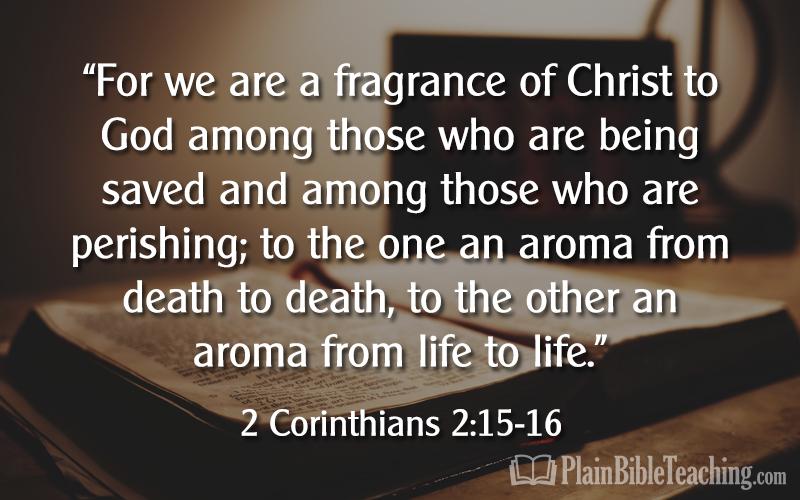
2 Corinthians 2:15-16

Often when people want to emphasize the serious nature of a matter, they describe it as “a matter of life or death.” The gospel is certainly a serious matter as it pertains to our eternal life or death (Romans 6:23). But in another sense, the gospel is a message of either life or death depending on how it is received by the one who hears it. Notice what Paul wrote to the brethren in Corinth:

For we are a fragrance of Christ to God among those who are being saved and among those who are perishing; to the one an aroma from death to death, to the other an aroma from life to life” (2 Corinthians 2:15-16).

For some, the gospel is a message “from life to life.” For others, it is a message “from death to death.” Which one depends on how the hearer perceives it. Let us notice the difference in perspectives.
Continue Reading

How to Reach Others with the Gospel

Two Men Studying the Bible

And He said to them, ‘Go into all the world and preach the gospel to all creation. He who has believed and has been baptized shall be saved; but he who has disbelieved shall be condemned” (Mark 16:15-16).

The above passage is commonly referred to as the Great Commission. Though this commission was given exclusively to the apostles (there is no divine mandate for each Christian to “go into all the world” today), there certainly are principles that apply to us. God wants people to be saved and the gospel is the way to reach them. Therefore, we should be doing what we can to spread the gospel.

But how do we reach others with the gospel? There is more to be done in this regard than just standing up in the pulpit and preaching (though this is one of the ways which we will discuss). Not everyone can stand up in the pulpit and preach, but each one of us can do different things to help reach others with the gospel.

In this article, we will briefly notice some of the things that we can do as individuals to spread the gospel.
Continue Reading

A New Creature

Therefore if anyone is in Christ, he is a new creature; the old things passed away; behold, new things have come” (2 Corinthians 5:17).

When Paul spoke of Christians (those “in Christ”) as being new creatures, he did not mean that we are no longer human as if we had become a new species. We remain human beings made in the image of God (Genesis 1:27). But there are significant changes that come when one becomes a disciple of Christ. Let us notice a few of the “new things” that come when one becomes a “new creature” in Christ.
Continue Reading

Sins of the Tongue

Statues Talking

When James discussed the use of the tongue (James 3:1-12), he made three basic points:

  1. One who can bridle the tongue can bridle the whole body as well: “For we all stumble in many ways. If anyone does not stumble in what he says, he is a perfect man, able to bridle the whole body as well” (James 3:2).
  2. The tongue is small, but powerful: “Now if we put the bits into the horses’ mouths so that they will obey us, we direct their entire body as well. Look at the ships also, though they are so great and are driven by strong winds, are still directed by a very small rudder wherever the inclination of the pilot desires. So also the tongue is a small part of the body, and yet it boasts of great things. See how great a forest is set aflame by such a small fire! And the tongue is a fire…” (James 3:3-6).
  3. The tongue cannot be tamed: “For every species of beasts and birds, of reptiles and creatures of the sea, is tamed and has been tamed by the human race. But no one can tame the tongue; it is a restless evil and full of deadly poison” (James 3:7-8).

In making these points, James taught a few lessons. Though sin is common among men (James 3:2), we are to strive to avoid the sins of the tongue. Furthermore, it is important that we avoid these sins because of the great amount of damage that can be done through them. Yet James said we cannot tame the tongue after telling us to control the tongue in order to avoid sin. Is this a contradiction? No, it is not.
Continue Reading

The Sixteen Apostles

16

You may be wondering about the title of this article. After all, were there not just twelve apostles? That is what children learn in Bible class. That is the number that immediately comes to mind for most Bible students of any age. If you count the men that Jesus chose during His time on the earth, there were just twelve apostles. But if you count every person mentioned in the Bible as being an apostle, you find not twelve, but sixteen.

Before noticing who these sixteen are, let us remember what the word apostle means. It is from the Greek word apostolos, which means one who is sent. In the context of Scripture, an apostle was one who was sent out on a divinely ordained mission with a message that came from above. His duty was to proclaim the good news of salvation.

So who were the sixteen apostles? We typically think of the twelve that were chosen by Jesus: Peter, Andrew, James, John, Philip, Bartholomew, Thomas, Matthew, James the son of Alphaeus, Thaddaeus, Simon, and Judas (Matthew 10:2-4). Besides these, we read of Matthias (Acts 1:26), Paul (Romans 1:1), Barnabas (Acts 14:14), and even Jesus Himself (Hebrews 3:1) being called apostles.

Not every one of the sixteen was the same type of apostle – Barnabas and Jesus particularly were distinct in different ways, as we will notice. But what they all have in common is that their apostleships help explain how God has chosen to reveal His word and how He desires that it be spread. So with this in mind, let us consider the sixteen apostles.
Continue Reading