Let No One Look Down on Your Youth

Holding a Bible

Paul told Timothy, “Let no one look down on your youthfulness, but rather in speech, conduct, love, faith and purity, show yourself an example of those who believe” (1 Timothy 4:12). The apostle’s instruction to the young evangelist will also apply to any young Christian. But how can young men and women in Christ keep others from looking down on their youth? They cannot control the thoughts of others. Instead, they must control what is in their power to control – they must live in such a way as to give no reason for others to look down on their youth.

Though one may be young, he can still be faithful and be an example in the areas Paul mentioned.
Continue Reading


Our Entertainment Culture

Darth Vader

Our society is saturated with entertainment in various forms – movies, television, music, internet videos, professional and collegiate sports, etc. Even during a time of economic hardship and uncertainty, Americans are paying billions of dollars a year in movie ticket sales alone. While occasional entertainment may be fine, we need to let our consumption of entertainment be regulated by the Scriptures.

In evaluating our entertainment consumption, we should ask ourselves some basic questions:
Continue Reading

Seek First His Kingdom

Matthew 6:33

In the Sermon on the Mount, Jesus warned against one dividing his allegiance to God. He said that an attempt to do this could not possibly be done with the Lord’s approval.

No one can serve two masters; for either he will hate the one and love the other, or he will be devoted to one and despise the other. You cannot serve God and wealth” (Matthew 6:24).

Jesus specifically mentioned wealth here as an object that would distract one from wholeheartedly serving God. But this principle is not limited to wealth. His point was that we must not allow anything to distract or hinder us from our service to God.
Continue Reading

Why Jesus Came to Save Us

The Lost Sheep

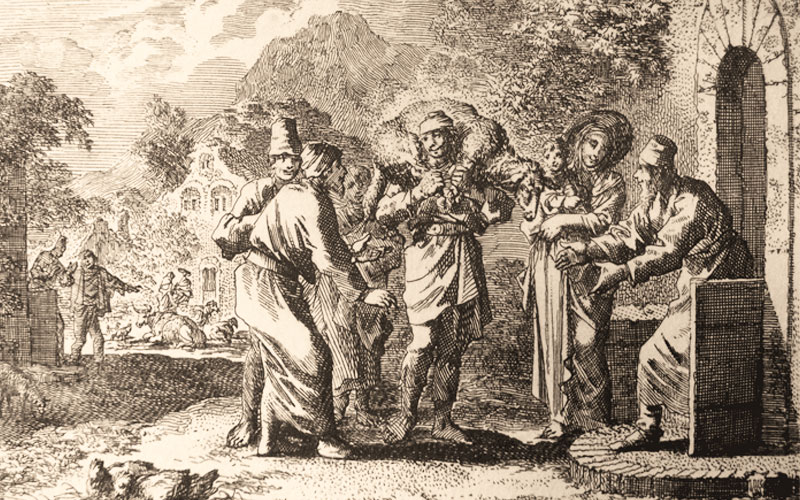
Why did Jesus come to save us? There are several answers we could give that would be correct: He loved us (John 15:13), the Father loved us (John 3:16), He needed to fulfill “the eternal purpose” (Ephesians 3:11), He wanted to “bring us to God” (1 Peter 3:18), and so on. But why did we need to be saved? Notice what Jesus said:

For the Son of Man has come to seek and to save that which was lost” (Luke 19:10).

Simply put, Jesus came to save us because we were lost. In Luke 15, Jesus used three parables to describe things that were lost: the lost sheep (Luke 15:3-7), the lost coin (Luke 15:8-10), and the lost son (Luke 15:11-24). When we consider these three parables, we learn several lessons: (1) why being lost is dangerous for us, (2) why the Lord saw fit to seek for us when we were lost, and (3) what our responsibility is in being saved.
Continue Reading

Hedges to Help Protect Us from Sin

Hedges

When Satan came before the Lord, God praised Job for his righteousness: “Have you considered My servant Job? For there is no one like him on the earth, a blameless and upright man, fearing God and turning away from evil” (Job 1:8). Satan, however, protested. In his mind, he believed that God was unfairly protecting Job from temptation: “Does Job fear God for nothing? Have You not made a hedge about him and his house and all that he has, on every side?” (Job 1:10). This “hedge” of divine blessing made Job less susceptible to temptation.

Of course, when God granted permission for this “hedge” to be removed, Job remained faithful (Job 1:22; 2:10). But the fact that Job had to work harder to resist the temptation to forsake God cannot be denied. Temptation was more severe when the “hedge” protecting Job was taken away.

As we make application to our lives, we should understand that we can have certain hedges to help protect us from sin. God has promised a way of escape so that every temptation can be defeated (1 Corinthians 10:13). The more hedges we have in place, the better we will be able to overcome temptation.

The only infallible safeguard against temptation is the word of God. The wise man wrote, “Every word of God is tested; He is a shield to those who take refuge in Him” (Proverbs 30:5). However, there are other hedges that we can put in place to help guard against temptation. We will consider a few of these in this article. We should understand that none of these safeguards are infallible, but they can greatly help if we use them properly.
Continue Reading

Should Preaching About Homosexuality Be a Priority?

Louie Giglio, pastor of the Passion City Church in Atlanta, was invited to deliver the benediction during the President’s inauguration. He has since withdrawn from participating in the event after some “gay-rights” advocates protested. The following quote was included in the article linked above. It is from a sermon of Giglio’s from the 1990’s and was the cause of the opposition against his participation in the inauguration.

“If you look at the counsel of the word of God, Old Testament, New Testament, you come quickly to the conclusion that homosexuality is not an alternative lifestyle… homosexuality is not just a sexual preference, homosexuality is not gay, but homosexuality is sin. It is sin in the eyes of God, and it is sin according to the word of God. You come to only one conclusion: homosexuality is less than God’s best for his creation.”

I know nothing about anything else Giglio teaches or has taught, but his remarks above about homosexuality being a sin are exactly correct. In every dispensation, homosexuality has been an abomination in the eyes of God. The cities of Sodom and Gomorrah were utterly destroyed for this sin (Genesis 19:4-13; Jude 7). The Law of Moses clearly condemned the practice: “You shall not lie with a male as one lies with a female; it is an abomination” (Leviticus 18:22; cf. 20:13). Even in the New Testament, homosexuality is said to be “unnatural,” “indecent,” and “contrary to sound teaching” (Romans 1:26-27; 1 Timothy 1:10). Paul told the brethren in Corinth that the sin of homosexuality, if not repented of and abandoned, would prevent one from inheriting the kingdom of God (1 Corinthians 6:9).
Continue Reading

Take Courage

In concluding His final address to the apostles before His arrest, Jesus told them to be courageous in the face of the hardships that would be coming against them.

These things I have spoken to you, so that in Me you may have peace. In the world you have tribulation, but take courage; I have overcome the world” (John 16:33).

Courage is the confidence and conviction to do what one knows to be right, regardless of the consequences. The apostles needed courage to carry out the Lord’s instructions without being deterred by the persecution that awaited them.

As Christians, we also need to have courage today. The Lord has left instructions for us to follow. We are to “observe all that [Christ] commanded” (Matthew 28:20). Furthermore, we are warned that we will become a target by following the Lord’s instructions. Paul said, “Indeed, all who desire to live godly in Christ Jesus will be persecuted” (2 Timothy 3:12).

How can we “take courage” (John 16:33) so that we will be able to endure the sufferings that will come for the cause of Christ?
Continue Reading