Introducing Jesus

Jesus – Sermon on the Mount

In the beginning was the Word, and the Word was with God, and the Word was God” (John 1:1).

And the Word became flesh, and dwelt among us, and we saw His glory, glory as of the only begotten from the Father, full of grace and truth” (John 1:14).

The gospel of John was written to teach people about Jesus. The first chapter introduces Jesus to us. We learn of Him through the various words and phrases used to describe the Lord, some of which are found in the verses above. The opening chapter of John is a good place to go to learn, be reminded, or teach others about Jesus. Let us briefly consider some of the ways in which Jesus is described in these verses.
Continue Reading
Reasons to Love Our Brethren

1 John 4:7

One of the themes emphasized in John’s first epistle is love. In particular, the inspired apostle stressed the importance of loving our brethren in Christ: “Beloved, let us love one another” (1 John 4:7). In this short letter, John provided at least nine reasons why we should love one another. Let us briefly notice each of these.

Why should we love our brethren?
Continue Reading

The Foundation for a Godly Society

Moses and the Ten CommandmentsThe Ten Commandments (Exodus 20:1-17) – the laws engraved onto stone which God delivered to Moses for the children of Israel – give us the blueprint for the foundation of any godly or righteous society. These Ten Commandments are regularly assaulted by those on the “left” as having no place in our government or our schools. The stated reason for their opposition is that the Ten Commandments represent a religious element that has no place in anything related to government. Yet the Ten Commandments represent more than just religion. The reason there is such strong opposition to the display of the Ten Commandments by the “left” is because the Ten Commandments stand in direct opposition to the Liberal’s ideal for society.

Many today view the Ten Commandments as part of the foundation of our religion. Yet they are part of the Old Law which was nailed to the cross (Colossians 2:14). Does this mean they are of no value for us today? Certainly not! But we must use them properly. The Old Testament was written and is preserved “for our instruction” (Romans 15:4). When we study the Ten Commandments, we find the foundations of a godly society.
Continue Reading

Some Things Never Change

Man on a Mountain at Night

As one year quickly draws to a close, it is customary for us to look back at the changes that have taken place in our lives and look ahead to changes that may be coming in the future. While our lives are filled with change, it is important for us to remember that there are some things that never change. In this brief article, I want us to be reminded of a few of these.
Continue Reading

Testing God

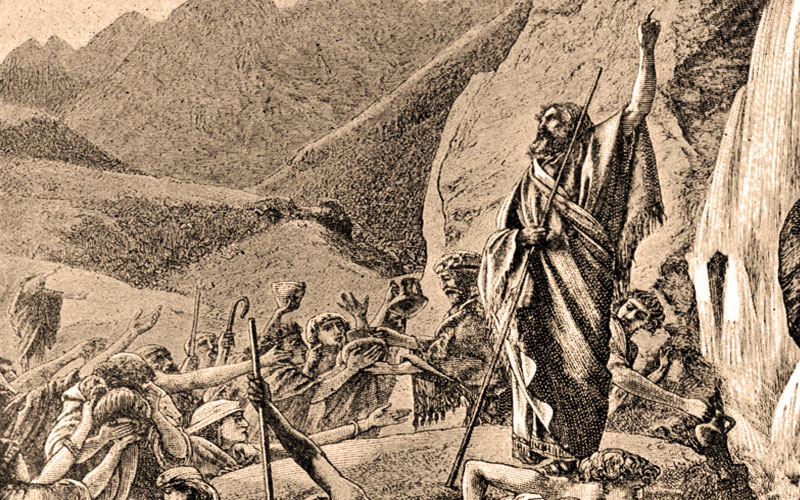
Moses Strikes the Rock

The Hebrew writer quoted the psalmist’s description of the Israelites testing God in the wilderness (Hebrews 3:7-11; cf. Psalm 95:7-11). Testing God is directly connected to one’s faith. Immediately after mentioning the Israelites testing God, the Hebrew writer warned about the danger of “an evil, unbelieving heart that falls away from the living God” (Hebrews 3:12). He closed the chapter with a statement about the “unbelief” exhibited by those who tested God (Hebrews 3:19).

In this article, we will briefly consider three examples given in Scripture that show how one can be guilty of testing God. After noting these examples, we will also consider the severe consequences of testing God so we might learn not to do this ourselves.
Continue Reading

Why Does the Earth Still Stand?

View of Earth from space

At the close of his second epistle, Peter told those to whom he wrote about the end of the world: “But the day of the Lord will come like a thief, in which the heavens will pass away with a roar and the elements will be destroyed with intense heat, and the earth and its works will be burned up” (2 Peter 3:10).

Because this day was coming “like a thief,” he wanted them to be prepared: “Since all these things are to be destroyed in this way, what sort of people ought you to be in holy conduct and godliness, looking for and hastening the coming of the day of God” (2 Peter 3:11-12). “Therefore, beloved, since you look for these things, be diligent to be found by Him in peace, spotless and blameless” (2 Peter 3:14). He wanted them to be living in a state of readiness knowing that the Lord could return at any time.

Approximately two thousand years later, the earth is still here. Why? It is important to understand that Peter’s words were not meant to suggest imminence (the end was soon), but unexpectedness (the end could come at any time). With this in mind, the Scriptures give three reasons why the earth has not yet been destroyed.
Continue Reading

What All Men Have in Common

Handshake

People are different. Sadly, there are some who unfairly judge or even hate others simply because they are of a different race, culture, economic class, etc. Christians are to “judge with righteous judgment” (John 7:24) and “abound in love for one another, and for all people” (1 Thessalonians 3:12). In order to do this, we need to remember what all men have in common rather than focus too much on certain differences that may exist.

In this article, we will consider seven things which all of us have in common.
Continue Reading