Gospel Preaching and Ice Cream Parties

Recently, a local church here in Bowling Green held a weekend gospel meeting. The announcement that appeared on the front page of their website inviting people to attend also contained an invitation to an “Ice Cream Meet n’ Eat” that would be held at the home of one of the members.

Incorporating this invitation into the announcement on the church’s website for the gospel meeting makes it easy for one to get the impression that this ice cream party was an official event sponsored and paid for by the church. The fact that it was located at a member’s house would not necessarily indicate that the church was uninvolved. A church might decide to host a social event at such a location in order to provide a more casual environment or because they church does not (yet) have a fellowship hall or similar facility in which to host the event on-site. Denominations host social events on their property and off-site all of the time. People are accustomed to these things happening. So even though social events have no place in the work of the church (cf. 1 Corinthians 11:22, 34), many people would not think twice about it.

Though I do not know this for a fact, I assume that this particular ice cream party was paid for by individual members and not by the congregation (even though the announcement somehow ended up on the church’s website embedded within the invitation to the gospel meeting). However, this does beg the question: Is it appropriate to use social events (like ice cream parties) as a means of enticing people to come listen to the gospel?
Continue Reading

Government Aid Hindering the Spread of the Gospel

The following is a quote from J.D. Tant (1861-1941) containing some of his observations about how government aid to the Indian tribes not only provided a disincentive for them to work, but also made it much more difficult to reach them with the gospel.
Continue Reading

“These Who Have Turned the World Upside Down”

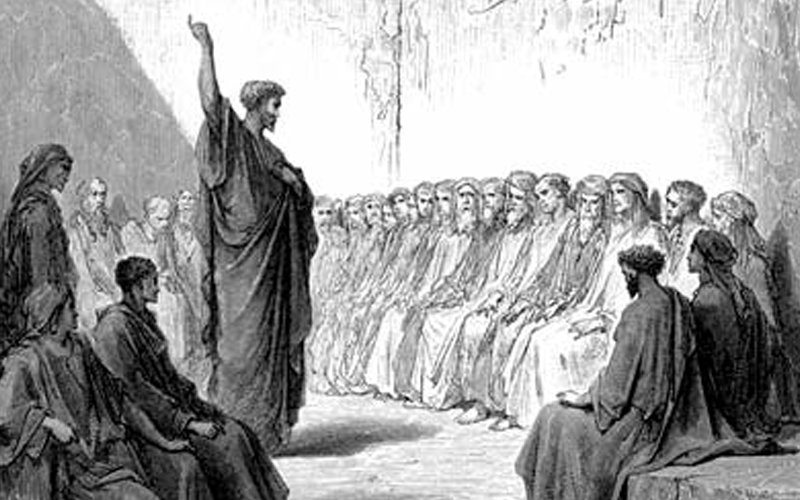
Paul preaching in Thessalonica

After just a few weeks of Paul preaching in Thessalonica, the gospel had been received by some of the Jews and “a large number of the God-fearing Greeks and a number of the leading women” (Acts 17:1-4). In an effort to try to silence this message, the Jews intended to capture Paul and Silas. When they could not find them, they took Jason and some of the brethren and brought them before the authorities in order to accuse them.

When they did not find them, they began dragging Jason and some brethren before the city authorities, shouting, ‘These men who have upset the world have come here also; and Jason has welcomed them, and they all act contrary to the decrees of Caesar, saying that there is another king, Jesus’” (Acts 17:6-7).

Continue Reading

By the Grace of God

Paul

In presenting evidence to support the resurrection of Christ, Paul told the brethren in Corinth of several eyewitnesses who could verify that Jesus did in fact rise from the dead. The last of these eyewitnesses that Paul mentioned was himself: “And last of all, as to one untimely born, He appeared to me also” (1 Corinthians 15:8).

At this point, Paul took a short break from his discussion about the historicity of Jesus’ resurrection to make a point about the grace of God:

For I am the least of the apostles, and not fit to be called an apostle, because I persecuted the church of God. But by the grace of God I am what I am, and His grace toward me did not prove in vain; but I labored even more than all of them, yet not I, but the grace of God with me. Whether then it was I or they, so we preach and so you believed” (1 Corinthians 15:9-11).

Paul made four points in these three verses about the grace of God. Let us consider these briefly.
Continue Reading

Soldiers of the Victorious Lamb

It is an inescapable reality that we are involved in a war – not the type of war that nations wage for wealth, resources, or territory; but a spiritual war for the souls of men (2 Corinthians 10:3-5). While the final outcome of a physical war is always unknown, the result of this spiritual war is certain. Notice what the book of Revelation says about the victory of Christ:

These will wage war against the Lamb, and the Lamb will overcome them, because He is Lord of lords and King of kings, and those who are with Him are the called and chosen and faithful” (Revelation 17:14).

Jesus will lead His army to victory. There is no uncertainty to this. What is uncertain is which side we will join. Will we choose to be on the Lord’s side? Or will we choose to fight against Him?
Continue Reading

Trying to Reach Heaven (1/3)

Thought from today’s Bible reading from Genesis 8-11.

They said, ‘Come, let us build for ourselves a city, and a tower whose top will reach into heaven, and let us make for ourselves a name, otherwise we will be scattered abroad over the face of the whole earth’” (Genesis 11:4).

This was the reasoning of those who proposed to build what would be called the Tower of Babel. There are several errors of which they were guilty that we could consider. But probably the most notable was in their attempt to reach heaven. They were determined to do it their way, without any sort of assistance from God.* So God put an end to their ambitions.
Continue Reading

Sounding Forth the Word

Tin can phone

The local church is God’s “missionary society” – the organization through which we work to spread the gospel. Though man has concocted many different schemes and systems since the time when Jesus established His church, the Lord’s design is for His message to be proclaimed through the work of individuals and local churches. Paul mentioned the church in Thessalonica as an example of how this simple arrangement can be successful.

For the word of the Lord has sounded forth from you, not only in Macedonia and Achaia, but also in every place your faith toward God has gone forth, so that we have no need to say anything” (1 Thessalonians 1:8).

Continue Reading