“The Poor Have the Gospel Preached to Them”

Jesus teaching

The common perception by people – from within the religious world and outside of it – is that churches are charitable organizations designed to help the poor. Denominational churches spend much time, energy, and money helping the poor. Those who are in need (or claim to be in need) often visit churches seeking a handout.

We are certainly to be concerned for the poor (Galatians 2:10; Ephesians 4:28; James 2:15-17) and, as we have opportunity (Galatians 6:10), help those with legitimate needs (cf. 2 Thessalonians 3:10 – “If anyone is not willing to work, then he is not to eat, either”). Yet the Lord’s church is not a charity. He did not design or ordain it to be one. Instead, He designed and ordained the church for another purpose that is far more important than mere benevolence.

When John sent some of his disciples to find evidence that Jesus was the promised Messiah (Matthew 11:2-3), one of the proofs that Jesus cited was that “the poor have the gospel preached to them” (Matthew 11:5). Jesus did not mention feeding the poor, clothing them, or giving them money. Instead, the proof offered to John’s disciples for Jesus’ identity was the fact that the poor were taught the good news of salvation.
Continue Reading

Lessons from the Limited Commission

We often remember the “Great Commission” in which Jesus told His apostles, “Go into all the world and preach the gospel to all creation” (Mark 16:15). However, prior to this, Jesus gave His apostles what we may call the “Limited Commission.” They were to “go to the lost sheep of the house of Israel” (Matthew 10:6).

Though we are living in the time since the giving of the Great Commission, there are still important lessons we can learn from the earlier Limited Commission that apply even today.
Continue Reading

What Do the Numbers Tell Us?

Chart

There is often a great deal of emphasis placed upon numbers in a congregation – membership, attendance, converts, etc. This is somewhat natural. We tend to want some way to gauge success or progress in our efforts. Yet numbers rarely tell the whole story and, in many ways, can even be deceiving. Rather than being quick to jump to conclusions based upon numbers, we should look to God’s word to gauge our success in carrying out His will.
Continue Reading

A Message of Life or Death

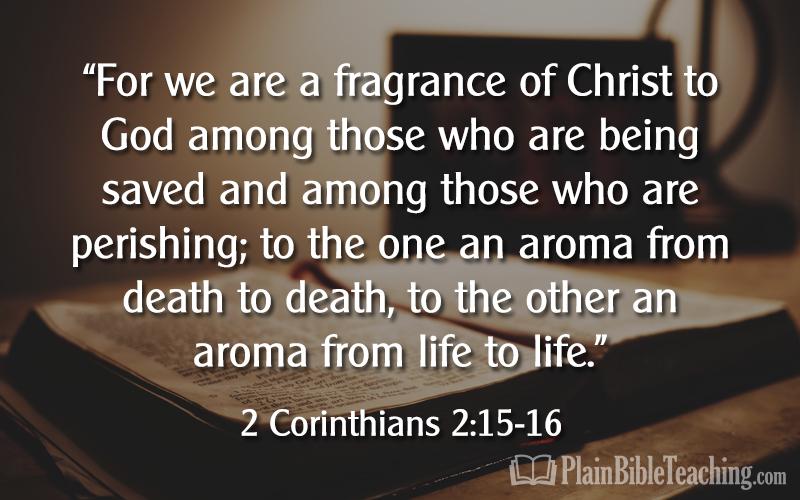
2 Corinthians 2:15-16

Often when people want to emphasize the serious nature of a matter, they describe it as “a matter of life or death.” The gospel is certainly a serious matter as it pertains to our eternal life or death (Romans 6:23). But in another sense, the gospel is a message of either life or death depending on how it is received by the one who hears it. Notice what Paul wrote to the brethren in Corinth:

For we are a fragrance of Christ to God among those who are being saved and among those who are perishing; to the one an aroma from death to death, to the other an aroma from life to life” (2 Corinthians 2:15-16).

For some, the gospel is a message “from life to life.” For others, it is a message “from death to death.” Which one depends on how the hearer perceives it. Let us notice the difference in perspectives.
Continue Reading

How to Reach Others with the Gospel

Two Men Studying the Bible

And He said to them, ‘Go into all the world and preach the gospel to all creation. He who has believed and has been baptized shall be saved; but he who has disbelieved shall be condemned” (Mark 16:15-16).

The above passage is commonly referred to as the Great Commission. Though this commission was given exclusively to the apostles (there is no divine mandate for each Christian to “go into all the world” today), there certainly are principles that apply to us. God wants people to be saved and the gospel is the way to reach them. Therefore, we should be doing what we can to spread the gospel.

But how do we reach others with the gospel? There is more to be done in this regard than just standing up in the pulpit and preaching (though this is one of the ways which we will discuss). Not everyone can stand up in the pulpit and preach, but each one of us can do different things to help reach others with the gospel.

In this article, we will briefly notice some of the things that we can do as individuals to spread the gospel.
Continue Reading

“Woe Is Me if I Do Not Preach the Gospel” (12/1)

Thought from today’s Bible reading from 1 Corinthians 9-11.

While Paul preached in Corinth, he received no financial support from the church there. He either worked to support himself or received “wages” from other churches for his work (Acts 18:1-5; 2 Corinthians 11:8-9). Yet in the first part of 1 Corinthians 9, Paul argued that he had “a right to refrain from working” as he preached the gospel among them (1 Corinthians 9:6). He pointed out the fact that it was God’s intention for preachers to be supported.

So also the Lord directed those who proclaim the gospel to get their living from the gospel” (1 Corinthians 9:14).

Yet because of circumstances in Corinth, Paul chose not to take advantage of what should have been expected – support from those among whom he labored (1 Corinthians 9:15). But why would Paul forgo support? And without adequate support, why would he keep preaching? Notice what he told them:

For if I preach the gospel, I have nothing to boast of, for I am under compulsion; for woe is me if I do not preach the gospel” (1 Corinthians 9:16).

Continue Reading

“Everywhere in Every Church” (11/29)

Thought from today’s Bible reading from 1 Corinthians 1-4.

When one looks at the religious world, it is easy to see the great diversity in doctrines and practices among the various churches. These doctrines are often conflicting with one another. The practices are sometimes very different from one church to another. Yet most people accept this as though it is to be expected. But it is not supposed to be this way. Notice what Paul told the brethren in Corinth:

For this reason I have sent to you Timothy, who is my beloved and faithful child in the Lord, and he will remind you of my ways which are in Christ, just as I teach everywhere in every church” (1 Corinthians 4:17).

Paul’s message was consistent as he went from one church to another. He did not tailor the gospel to fit with the desires, traditions, or opinions of those he met. He preached the same gospel “everywhere in every church.
Continue Reading