Introducing Jesus

Jesus – Sermon on the Mount

In the beginning was the Word, and the Word was with God, and the Word was God” (John 1:1).

And the Word became flesh, and dwelt among us, and we saw His glory, glory as of the only begotten from the Father, full of grace and truth” (John 1:14).

The gospel of John was written to teach people about Jesus. The first chapter introduces Jesus to us. We learn of Him through the various words and phrases used to describe the Lord, some of which are found in the verses above. The opening chapter of John is a good place to go to learn, be reminded, or teach others about Jesus. Let us briefly consider some of the ways in which Jesus is described in these verses.
Continue Reading

Stop Sinning: Can You? Should You? Will You?

Stop sign

In His word, God has defined certain things as sin – fornication, idolatry, covetousness, strife, drunkenness, murder, lying, and more (1 Corinthians 6:9-10; Galatians 5:19-21; 1 Timothy 1:9-10; Revelation 21:8; et al.). The Scriptures also present a very clear instruction with regard to sin: “Become sober-minded as you ought, and stop sinning” (1 Corinthians 15:34).

It is to be expected that those in the world will ignore this instruction. Yet, sadly, many Christians seem to ignore this as well. They have believed the Calvinist’s lie that our flesh is inherently sinful and that we cannot help but sin. As we will see, the Scriptures present a different reality. Living in the flesh means it is possible for us to sin (1 John 1:10-2:1); but we are called to “be perfect, as [our] heavenly Father is perfect” (Matthew 5:48). With that in mind, let us consider three questions in this article.
Continue Reading

Bringing Up Children in the Lord (Part 6): Raising Children to Be Christians

Bringing Up Children in the Lord

I have no greater joy than this, to hear of my children walking in truth” (3 John 4).

Though the passage above refers to Christians in general, the principle certainly applies to the relationship between parents and children. As parents strive to “bring [their children] up in the discipline and instruction of the Lord” (Ephesians 6:4), the ultimate goal is to lead them to the Lord. Naturally, parents will hope that their children enjoy good health and a degree of prosperity in this life. But in the end, what matters most is that their “soul prospers” as they walk “in the truth” (3 John 2, 4). So in this final lesson, we will focus on raising children to be Christians.
Continue Reading

Characteristics of Truth

Man Holding Bible

The sum of Your word is truth, and every one of Your righteous ordinances is everlasting” (Psalm 119:160).

David affirmed that the entirety of God’s word – the sum, not just some – is truth. This is what we should expect since the word is from God (1 Corinthians 1:10-13; 2 Timothy 3:16) and “it is impossible for God to lie” (Hebrews 6:18; cf. Titus 1:2).

While it is important that we understand that the word of God is truth (John 17:17), it is also important that we appreciate various characteristics of truth. Certainly there are those who do not accept the Bible as truth; but of those who do (or claim that they do), many simply do not understand the nature of this truth. It is not whatever we want it to be. Truth is from the mind of God whose ways are infinitely higher than our own (Isaiah 55:8-9; 1 Corinthians 1:25). So let us consider some of the characteristics of truth.
Continue Reading

Lessons from the Conversion of Apollos

There are several accounts of people being converted to Christ in the book of Acts. One such example was the conversion of Apollos in Ephesus.

Now a Jew named Apollos, an Alexandrian by birth, an eloquent man, came to Ephesus; and he was mighty in the Scriptures. This man had been instructed in the way of the Lord; and being fervent in spirit, he was speaking and teaching accurately the things concerning Jesus, being acquainted only with the baptism of John; and he began to speak out boldly in the synagogue.

But when Priscilla and Aquila heard him, they took him aside and explained to him the way of God more accurately. And when he wanted to go across to Achaia, the brethren encouraged him and wrote to the disciples to welcome him; and when he had arrived, he greatly helped those who had believed through grace, for he powerfully refuted the Jews in public, demonstrating by the Scriptures that Jesus was the Christ” (Acts 18:24-28).

Continue Reading

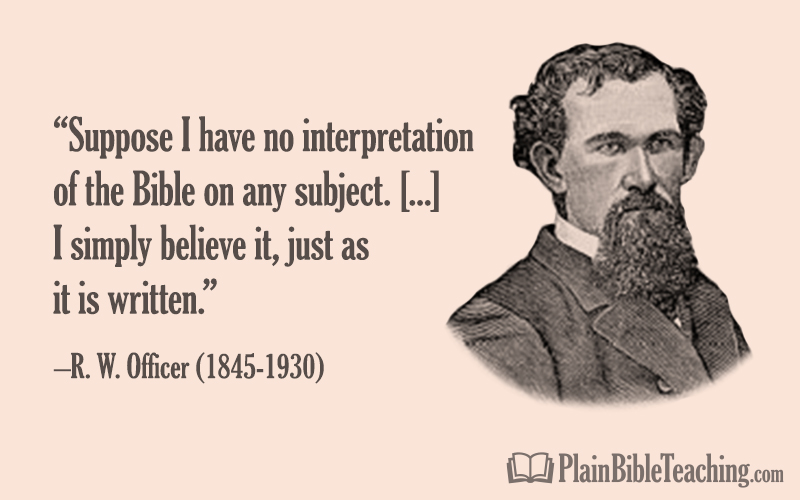
R.W. Officer: “Suppose I Have No Interpretation of the Bible on Any Subject”

R. W. Officer: No Interpretation

Robert Wallace Officer (1845-1930), at one point in his life, served as a missionary for the Liberty Baptist Association. During this six year period, he faced several charges of heresy. Below is an excerpt from a heresy trial in which Dr. J.R. Graves examined him to determine his “soundness of faith.”
Continue Reading

Teaching the Next Generation

Family Portrait

It has been said before that the church is just one generation away from apostasy. This is certainly true. While there are exceptions to any rule, generally what the wise man said is accurate: “Train up a child in the way he should go, even when he is old he will not depart from it” (Proverbs 22:6). If we want children to follow the way of truth when they grow up, they must be taught the way of truth while they are growing up.

As we raise the next generation, we should focus on this question: Why do we believe, teach, and practice what we do? This is important. We are to “please [God] in all respects” (Colossians 1:10). The next generation must be taught to please God as well. But if we do not teach them how to do this, what will they do when they are grown?
Continue Reading