The Limitations of Man

Man on a mountain

The word of the Lord came again to me, saying, ‘Son of man, say to the leader of Tyre, “Thus says the Lord God, ‘Because your heart is lifted up and you have said, “I am a god, I sit in the seat of gods in the heart of the seas”; yet you are a man and not God, although you make your heart like the heart of God’”’” (Ezekiel 28:1-2).

Man has been made in God’s image (Genesis 1:26-27), but man does not share all of the attributes of God. In the passage above, the king of Tyre was condemned because he arrogantly thought of himself as being equal with God. He had certainly made great accomplishments in gaining wisdom and acquiring riches (Ezekiel 28:3-5), but God would prove to him that he was just a man: “Will you still say, ‘I am a god,’ in the presence of your slayer, though you are a man and not God, in the hands of those who wound you?” (Ezekiel 28:9).

We must recognize that as human beings, there are certain limitations that are placed upon us. Understanding this should cause us to be humble and to submit to the will of God. In this article, we are going to consider some of these limitations and see, in contrast, the greatness of God.Continue Reading

The Christian’s Boast

Man in front of waterfall

In the first half of Romans 5, Paul explained how Christians have been justified by faith and by the sacrifice of Christ on the cross (Romans 5:1-11). In this passage, Paul used the word exult three times (NASB). This is not a term we commonly use today. The King James Version uses three different terms instead – rejoice, glory, and joy. The word means to boast about something (Thayer).

Usually we would think of boasting as something that we should not do as Christians. Yet it depends on the context. Paul told the brethren in Corinth, “Let him who boasts, boast in the Lord” (1 Corinthians 1:31). If the word of God indicates that we are to boast, glory, and rejoice in something, then we can and should do so.

In this article, we will notice the three things Paul indicated in this passage in which we are to boast.Continue Reading

Practicing Church Discipline

Empty pews

Church discipline is often not a pleasant topic to discuss and is even more difficult to practice. Because of this, some congregations hardly discuss it at all. Then when a situation arises that requires it, they are either unsure how to proceed or they ignore it altogether and hope the problem simply goes away.

However, while church discipline is often difficult and painful to practice, there are times when it is absolutely necessary. Furthermore, the Scriptures show us that when it is done for the right reason and in the right way, it is actually for the good of the congregation and of the one from whom the church withdrew fellowship.

In this article, we are going to consider several passages in the New Testament that talk about this topic; but we will use Paul’s instructions in 1 Corinthians 5 as the outline for our study.Continue Reading

“Follow Me”

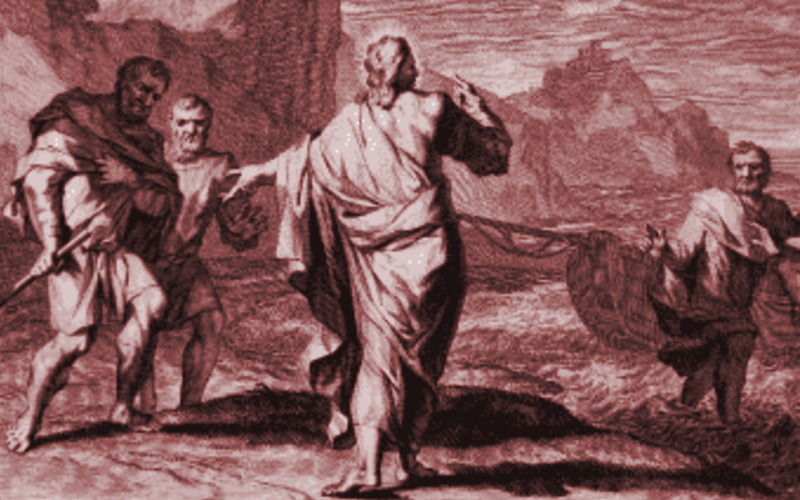
Jesus Calls the First Apostles

Go therefore and make disciples of all the nations, baptizing them in the name of the Father and the Son and the Holy Spirit, teaching them to observe all that I commanded you; and lo, I am with you always, even to the end of the age” (Matthew 28:19-20).

In the Great Commission, Jesus told His apostles to go out and make disciples. A disciple is a follower of Jesus. Therefore, the Great Commission was about finding people who would follow Jesus.

This is also what Jesus did while on the earth – He made disciples. But while His apostles would call people to follow Jesus, He would tell them, “Follow Me.

There are a few examples in the gospels in which Jesus offered this invitation – “Follow Me.” In this article, we are going to look at these statements in the book of Matthew and make some applications.Continue Reading

Resolutions from the Last Will and Testament of the Springfield Presbytery

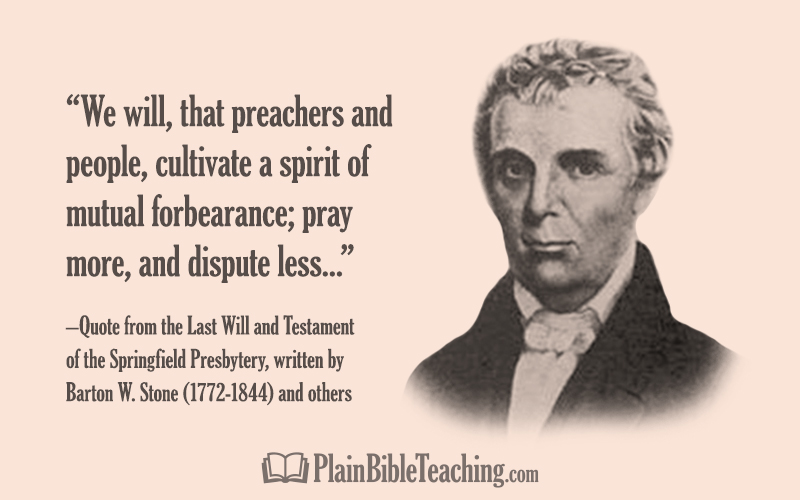
Mutual forbearance

On June 28, 1804, Barton W. Stone (1772-1844) and five other men signed the Last Will and Testament of the Springfield Presbytery. This document was one of the most significant of the Restoration Movement. It expressed a desire to dissolve their recently-formed body (the Springfield Presbytery) as they recognized that all such denominational bodies and creeds were inherently divisive. The Last Will and Testament also encouraged the members of other such bodies to do the same and unite together simply upon the teachings of the Bible.

“We will, that this body die, be dissolved, and sink into union with the Body of Christ at large; for there is but one Body, and one Spirit, even as we are called in one hope of our calling.”

“We will, that the people henceforth take the Bible as the only sure guide to heaven; and as many as are offended with other books, which stand in competition with it, may cast them into the fire if they choose; for it is better to enter into life having one book, than having many to be cast into hell.”

“Finally, we will that all our sister bodies read their Bibles carefully, that they may see their fate there determined, and prepare for death before it is too late.”

Continue Reading

Top 5 Articles on Plain Bible Teaching in 2020

Top 5 Articles in 2020

Well, we’ve reached the end of an eventful year. It’s important to take time at the end of a year to reflect on what has happened as we prepare for what will be coming in the future. Here on Plain Bible Teaching, one of the ways I do this is by going back and seeing what were the most-read articles on the site for this year. It’s always interesting to see what made the list. Normally the list of top 5 older articles stays pretty consistent, but this year it is quite different from previous years. I’m posting the list here as a record for myself and because it may be of interest to you as well. So here are the “top 5” posts based on the number of page views.Continue Reading

Book Review: Marx, Lenin, and Jesus

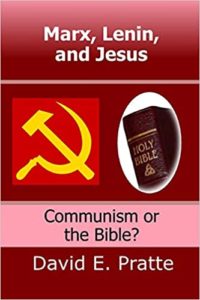
Marx, Lenin, and Jesus (cover)After an election season, many may be burned out by politics. However, the subject of this book is still an important topic and one that is more than just a political one. The book we will review here is one that I recently read: Marx, Lenin, and Jesus: Communism or the Bible? by David E. Pratte.Continue Reading