How to Find the Way of Escape

Esc key

No temptation has overtaken you but such as is common to man; and God is faithful, who will not allow you to be tempted beyond what you are able, but with the temptation will provide the way of escape also, so that you will be able to endure it” (1 Corinthians 10:13).

In Paul’s letter to the church in Corinth, he told the brethren that temptation is “common to man.” In other words, it is to be expected. Unfortunately, all of us have given in to temptation at one time or another. Paul wrote, “For all have sinned and fall short of the glory of God” (Romans 3:23).

However, even though we have sinned in the past, that does not mean that we must do so again in the future, giving in to the same temptations over and over. We need to learn how to find the “way of escape” so that we might keep ourselves from sin. In this article, we will discuss what the Scriptures teach about how to find the way of escape.
Continue Reading

Teaching Questions

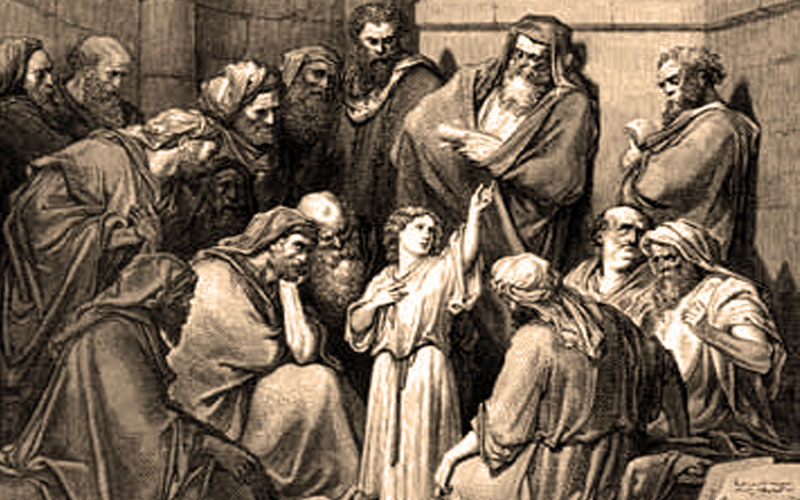
Jesus as a Boy in the Temple

In our last article, we looked at some good questions asked of a teacher that related to spiritual things. However, not all questions are asked by those needing information. Sometimes questions are asked by a teacher as a way to challenge his audience. Notice the example of Jesus when He was a young boy:

Then, after three days they found Him in the temple, sitting in the midst of the teachers, both listening to them and asking questions. And all who heard Him were amazed at His understanding and His answers” (Luke 2:46-47).

Jesus was God in the flesh (John 1:1, 14). He was not asking questions because He lacked understanding and was seeking instruction. He asked questions as a way to teach. The understanding and answers He imparted while His flesh and blood body was just twelve years old amazed those who heard Him.

This was not the only time Jesus employed this method of teaching. In this article, we will notice just a few examples in the Scriptures of questions that were asked by teachers as a way to lead their hearers to the truth.
Continue Reading

Good Question

Question Marks

Asking questions is a good way for one to learn about the truths taught in the Bible. Even when the questioner is not seeking knowledge, but attempting to cast doubt or attack the Bible believer, questions can often provide an opportunity to teach others as the critic is answered.

The Bible contains several examples of good questions – some by those who were honestly seeking the truth, some by those who were trying to attack the truth. Examining these questions will help us to learn or be reminded of some important lessons that God has revealed to us in His word. So in this article, we will look at some of these good questions that we find in the Scriptures.
Continue Reading

Continue in the Grace of God

For by grace you have been saved…” (Ephesians 2:8). The fact that salvation is by grace is one of the few points on which most – if not all – self-proclaimed Bible believing Christians will agree. But though we will all agree on the concept of salvation by grace, there is disagreement when you get below the surface.

A common misconception in the religious world is that we are saved by grace alone. Those who believe this will contend that salvation is wholly in the hands of God and that man can do nothing to impact his salvation – either to become saved or to remain saved. This doctrine of grace saving us unconditionally is completely false. Paul said, “The grace of God has appeared, bringing salvation to all men” (Titus 2:11). But this simply means that God has made salvation available to all men by His grace. It does not mean that all will be saved. Jesus made it clear that many would go down the path that leads to destruction (Matthew 7:13-14).

When Paul and Barnabas were teaching in Antioch of Pisidia, Luke recorded a summary of their message that helps present a picture for us as to what Christians need to remember with regard to God’s grace.
Continue Reading

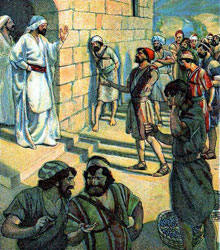
The Laborers in the Vineyard

Parables like the one we will examine in this article help explain the nature of Christ’s kingdom and the responsibility of its citizens. Let us notice the parable of the laborers in the vineyard:

Parable of the Laborers in the VineyardFor the kingdom of heaven is like a landowner who went out early in the morning to hire laborers for his vineyard. When he had agreed with the laborers for a denarius for the day, he sent them into his vineyard.



And he went out about the third hour and saw others standing idle in the market place; and to those he said, ‘You also go into the vineyard, and whatever is right I will give you.’ And so they went. Again he went out about the sixth and the ninth hour, and did the same thing. And about the eleventh hour he went out and found others standing around; and he said to them, ‘Why have you been standing here idle all day long?’ They said to him, ‘Because no one hired us.’ He said to them, ‘You go into the vineyard too.’

When evening came, the owner of the vineyard said to his foreman, ‘Call the laborers and pay them their wages, beginning with the last group to the first.’ When those hired about the eleventh hour came, each one received a denarius. When those hired first came, they thought that they would receive more; but each of them also received a denarius. When they received it, they grumbled at the landowner, saying, ‘These last men have worked only one hour, and you have made them equal to us who have borne the burden and the scorching heat of the day.’ But he answered and said to one of them, ‘Friend, I am doing you no wrong; did you not agree with me for a denarius? Take what is yours and go, but I wish to give to this last man the same as to you. Is it not lawful for me to do what I wish with what is my own? Or is your eye envious because I am generous?’ So the last shall be first, and the first last” (Matthew 20:1-16).

In this article, we will briefly examine six lessons we can learn from this parable.
Continue Reading

The Head Covering

The issue over the head covering has been controversial at times among brethren. It is something about which people are often curious. I regularly receive questions on a wide range of Bible topics. The head covering is easily one of the more asked about subjects. The main part of the passage discussing the covering is this:

But I want you to understand that Christ is the head of every man, and the man is the head of a woman, and God is the head of Christ. Every man who has something on his head while praying and prophesying disgraces his head. But every woman who has her head uncovered while praying or prophesying disgraces her head, for she is one and the same as the woman whose head is shaved. For if a woman does not cover her head, let her also have her hair cut off; but if it is disgraceful for a woman to have her hair cut off or her head shaved, let her cover her head” (1 Corinthians 11:3-6).

Is the head covering discussed by Paul an artificial covering or does it refer to a woman’s hair? Is it just a matter of culture or does it apply to all Christian women of all time? These are some questions people have when they study this passage. In this article, we will examine what Paul wrote in this chapter about the head covering.
Continue Reading

Not Getting Anything Out of the Assembly

Worship

I was glad when they said to me, ‘Let us go to the house of the Lord’” (Psalm 122:1).

David expressed the attitude that we must have when it comes to assembling to worship the Lord – gladness. The assembly of the saints ought to be something to which we look forward.

Unfortunately, many do not look forward to this time. But rather than acknowledging their own poor attitude and making efforts to change their mindset, they often attempt to shift the blame to others. They will say, “I’m not getting anything out of the assembly!” In their minds, this provides justification for them to complain, become sporadic in their attendance, or quit assembling altogether.

In this article, we will focus on the attitude of one who claims to be getting nothing out of the assembly of the church. It is a dangerous attitude and we must guard ourselves against it.
Continue Reading