Do Not Exceed What Is Written

Hand on Bible

Now these things, brethren, I have figuratively applied to myself and Apollos for your sakes, so that in us you may learn not to exceed what is written, so that no one of you will become arrogant in behalf of one against the other” (1 Corinthians 4:6).

Paul had to address several problems in his first letter to Corinth. One had to do with the brethren elevating men and regarding them as more important than they were. The apostle used himself and Apollos as an example in order to teach them “not to exceed what is written.” His warning was for them to not go beyond the limits of what God’s word allows. This principle is found throughout the letter. In this article, we will consider some points that Paul addressed in this letter in order to teach us – or remind us – not to exceed what is written and go beyond the boundaries of God’s word.
Continue Reading

Not Ashamed of the Gospel

Romans 1:16

For I am not ashamed of the gospel, for it is the power of God for salvation to everyone who believes, to the Jew first and also to the Greek. For in it the righteousness of God is revealed from faith to faith; as it is written, ‘But the righteous man shall live by faith’” (Romans 1:16-17).

When Paul wrote to the saints in Rome, he said he was “not ashamed of the gospel” (Romans 1:16). Because of the confidence he had in Christ’s message, he was “eager to preach the gospel” (Romans 1:15) and do many other things in the cause of Christ.

We need to have the same confidence as Paul so that we can also say, “I am not ashamed of the gospel” (Romans 1:16). Can we say this? To answer that question, we need to consider what we would be willing to do with and for the gospel.
Continue Reading

A Letter to Little Children

1 John

Seven times in John’s first epistle, he referred to his audience as “little children.” He was not writing to actual “little children.” He was writing to Christians. But Christians are to be like “little children” – innocent and in need of guidance and protection. We are also “children of God” (1 John 3:1). In this article, I want us to consider the seven instructions that John gave to the “little children” and see what we should also do today.
Continue Reading

Why Were They Called “churches of Christ”?

Church of Christ

Greet one another with a holy kiss. All the churches of Christ greet you” (Romans 16:16).

Paul referred to the congregations with which he was associated as “churches of Christ.” Many brethren, in an effort to follow the New Testament pattern, have also used this to identify local churches. However, some brethren have quit using this designation, choosing instead to identify themselves as “The Church in ___” or merely placing a sign in front of their building that says, “Christians Meet Here.” Of course, many more in the denominational world use other names to identify their churches (Baptist, Methodist, Catholic, etc.).

Our desire must be to please Christ and serve Him faithfully. So let us consider this question: Why were those local churches in the first century called “churches of Christ” and what bearing does this have on us today?
Continue Reading

Great Faith and Little Faith

Walking on Water

Jesus spoke of some as having great faith and others having little faith. What is the difference between these two types of faith?

As Christians, if we examine ourselves, we will likely find similarities in both categories. Where we have great faith, we must continue. Where we have little faith, we must improve. The Hebrew writer said, “And without faith it is impossible to please Him…” (Hebrews 11:6). Let us consider the differences between great faith and little faith so that we can learn how to best please the Lord.
Continue Reading

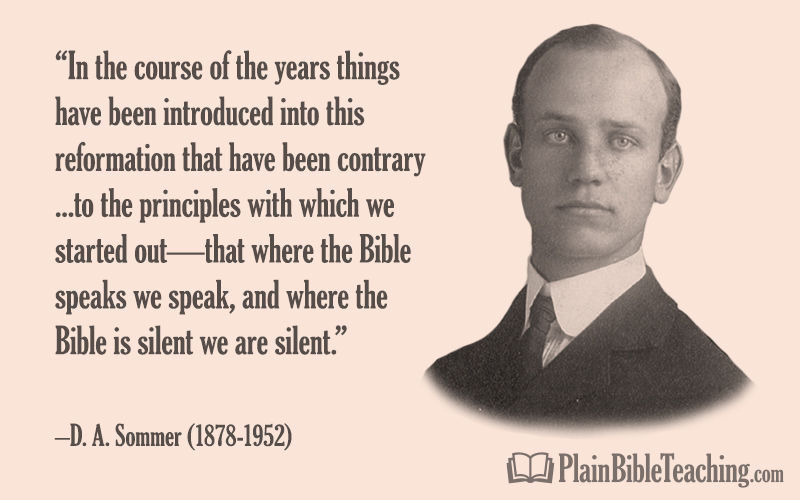
D.A. Sommer: The Same Movement, Yet We Are Different

D.A. Sommer: The Same Movement

Daniel Austen Sommer (1878-1952) was the son of the gospel preacher Daniel Sommer. In 1916, D.A. Sommer debated J. Roy Wright of the Christian church. The debate dealt with several issues, including instrumental music in worship and missionary societies. In his first speech, Sommer pointed out something that he and Wright had in common.
Continue Reading

Happy Birthday, Jesus?

Nativity Scene

For most of us, the holidays are for spending time with family and enjoying the blessings that we have in this life. But for many in the religious world, the Christmas holiday is also a time for them to celebrate the birth of Jesus. Some even believe that Jesus was born on December 25th. Therefore, they observe Christmas (December 25th) as a religious holy day. However, there are two problems with this:
Continue Reading