“Consider Your Ways!”

Haggai 1:7

Haggai prophesied during the reign of King Darius (Haggai 1:1). This man was referred to elsewhere as “Darius the Mede” (Daniel 5:31) and “Darius king of Persia” (Ezra 4:24). He was the head of the Medes and Persians when they overthrew Babylon (Daniel 5:28, 30-31).

Haggai prophesied about the need to rebuild the temple. This was necessary because the temple – as well as the city of Jerusalem – had previously been destroyed by the Babylonians (2 Kings 25:8-9). Later, God called Cyrus king of Persia to allow the temple to be rebuilt (Ezra 1:1-2). However, these reconstruction efforts were stopped by threat of force (Ezra 4:4-7, 23-24). Work on the temple would not resume again until the reign of Darius (Ezra 4:24; Haggai 1:1).

As the people were instructed to rebuild the temple, they were also told to consider their ways (Haggai 1:5, 7). It is important for us to consider the lessons revealed by the prophet Haggai.
Continue Reading

Teaching Questions

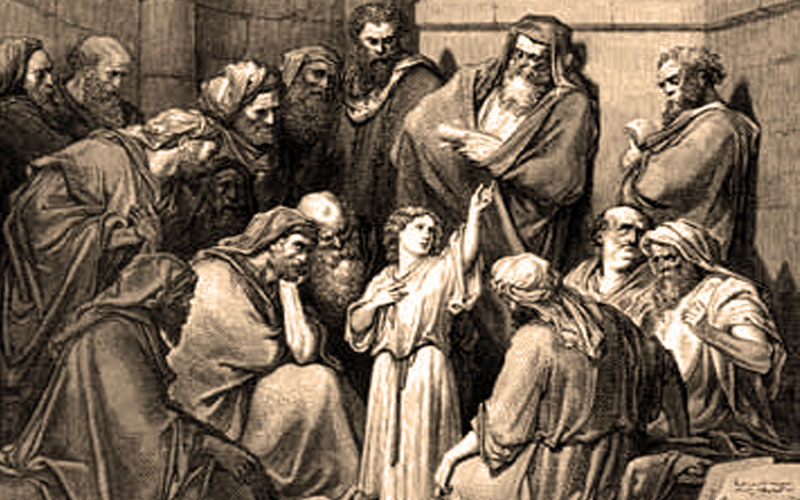
Jesus as a Boy in the Temple

In our last article, we looked at some good questions asked of a teacher that related to spiritual things. However, not all questions are asked by those needing information. Sometimes questions are asked by a teacher as a way to challenge his audience. Notice the example of Jesus when He was a young boy:

Then, after three days they found Him in the temple, sitting in the midst of the teachers, both listening to them and asking questions. And all who heard Him were amazed at His understanding and His answers” (Luke 2:46-47).

Jesus was God in the flesh (John 1:1, 14). He was not asking questions because He lacked understanding and was seeking instruction. He asked questions as a way to teach. The understanding and answers He imparted while His flesh and blood body was just twelve years old amazed those who heard Him.

This was not the only time Jesus employed this method of teaching. In this article, we will notice just a few examples in the Scriptures of questions that were asked by teachers as a way to lead their hearers to the truth.
Continue Reading

Audio: Gospel Meeting at the Eastside church of Christ

I had the privilege of speaking in a Gospel Meeting at the Eastside church of Christ in Morgantown, KY this past week – October 17-19, 2013. The three lessons I preached are listed below.
Continue Reading

Good Question

Question Marks

Asking questions is a good way for one to learn about the truths taught in the Bible. Even when the questioner is not seeking knowledge, but attempting to cast doubt or attack the Bible believer, questions can often provide an opportunity to teach others as the critic is answered.

The Bible contains several examples of good questions – some by those who were honestly seeking the truth, some by those who were trying to attack the truth. Examining these questions will help us to learn or be reminded of some important lessons that God has revealed to us in His word. So in this article, we will look at some of these good questions that we find in the Scriptures.
Continue Reading

Continue in the Grace of God

For by grace you have been saved…” (Ephesians 2:8). The fact that salvation is by grace is one of the few points on which most – if not all – self-proclaimed Bible believing Christians will agree. But though we will all agree on the concept of salvation by grace, there is disagreement when you get below the surface.

A common misconception in the religious world is that we are saved by grace alone. Those who believe this will contend that salvation is wholly in the hands of God and that man can do nothing to impact his salvation – either to become saved or to remain saved. This doctrine of grace saving us unconditionally is completely false. Paul said, “The grace of God has appeared, bringing salvation to all men” (Titus 2:11). But this simply means that God has made salvation available to all men by His grace. It does not mean that all will be saved. Jesus made it clear that many would go down the path that leads to destruction (Matthew 7:13-14).

When Paul and Barnabas were teaching in Antioch of Pisidia, Luke recorded a summary of their message that helps present a picture for us as to what Christians need to remember with regard to God’s grace.
Continue Reading

Take Courage: Introduction

Take Courage

In concluding His final address to the apostles before His arrest, Jesus told them to be courageous in the face of the hardships that would be coming against them.

These things I have spoken to you, so that in Me you may have peace. In the world you have tribulation, but take courage; I have overcome the world” (John 16:33).

Courage is the confidence and conviction to do what one knows to be right, regardless of the consequences. The apostles needed courage to carry out the Lord’s instructions without being deterred by the persecution that awaited them.

As Christians, we also need to have courage today. The Lord has left instructions for us to follow. We are to “observe all that [Christ] commanded” (Matthew 28:20). Furthermore, we are warned that we will become targets by following the Lord’s instructions. Paul said, “Indeed, all who desire to live godly in Christ Jesus will be persecuted” (2 Timothy 3:12).
Continue Reading

Who Calls You a Christian?

Thinking young man

If you were on trial for being a Christian, would there be enough evidence to convict you? That question, or a variation of it, has been asked many times in order to remind us all of the importance of letting our lights shine (Matthew 5:16), being ready to give an answer (1 Peter 3:15), and defending the truth (Philippians 1:16-17). We need to live in such a way that others can see Christ living in us (Galatians 2:20).

However, while the question raised in the first paragraph is good, there is another point that is just as important for us to consider. Just because the world sees you as a Christian, that does not necessarily mean that God sees you that way, too. To illustrate this point, notice what Paul said about the adulteress in his letter to the Romans:
Continue Reading