The “Serious Sin” of “Proselytism” (02.16.23)

Subscribe: Apple Podcasts | Google Podcasts | Stitcher | Spotify | RSS

Plain Bible Teaching Podcast

This week I’m joined once again by Kristofer Gardana, and we’re talking about some comments made by the pope in which he condemned the “serious sin” of “proselytism.” What did he mean by that? Is it anything like evangelism, or is it something different? And how should we, as Christians, view our responsibility regarding evangelism? We’re going to cover this in our discussion.Continue Reading

Barton W. Stone: The Preachers Are Working While the People Are Gazing

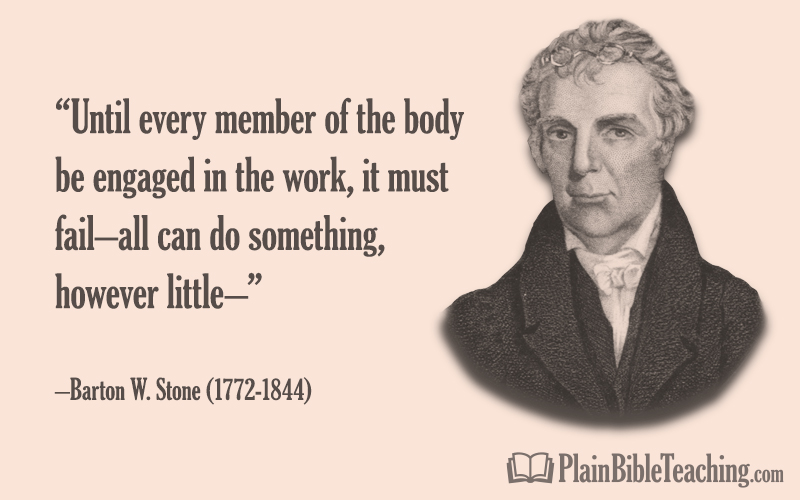
Stone: All Can Do Something

Barton W. Stone (1772-1844) was one of the leading voices for a movement that began in the early nineteenth century to reject the man-made doctrines and creeds of the religious world and enjoy unity on the Bible alone. This is sometimes referred to as the Stone-Campbell Movement due to the influence of Stone (along with Alexander Campbell) among Christians during that time. This message of “restoration” spread and many were won to the cause of Christ.

However, near the end of his life, Stone wrote that this movement had not continued to grow as he believed it could or should have. After traveling through Indiana, Ohio, and Kentucky, the elder Stone wrote in his journal – the Christian Messenger – about what he had observed and why he believed that more progress had not been made. Notice one of the reasons given:

“Another reason is that the preachers are almost solely engaged in working in the Lord’s vineyard, while the people and professors are gazing on without employment, without praying, without exhorting one another, without instructing, admonishing and comforting the young converts, and without building them up in the most holy faith. Until every member of the body be engaged in the work, it must fail—all can do something, however little—all are hired into the vineyard—all must labor or lose the reward.” (A Plea for the Union of All Christians, p. 292-293)

Stone observed that the preachers of the gospel were busy doing the Lord’s work. However, the rest of the brethren were “gazing on” and not helping in the work of teaching, exhorting, and encouraging others – particularly the new converts. As long as this was going on, he said “the work…must fail.”Continue Reading

Answering Basic Questions (Part 5): What Is the Gospel?

Answering Basic Questions

We often talk about the importance of preaching the gospel. But what does that mean? The gospel is foundational to our faith. Therefore, if we are to be “ready to make a defense…for the hope that is in [us]” (1 Peter 3:15), then we ought to be able to concisely explain it to others.

So what is the gospel? Let us consider four points here.Continue Reading

The Hills and Vales of Bethany

Alexander Campbell's study

Alexander Campbell (1788-1866) is recognized as one of the leading figures in the Restoration Movement. However, his influence did not come as a result of him preaching for a large congregation or because he lived in some big city. Instead, he lived “among the hills of Western Virginia” as Moses E. Lard wrote in the excerpt below. In fact, Lard suggested that the place in which Campbell resided was surprisingly advantageous to him and his work.

“Besides, we can not but think that the very location he chose for his home was specially designed for him in the providence of God, and that it had no small influence on the great work he did. He sat down among the hills of Western Virginia, on the little stream of Buffalo, amid a hardy, simple population, who had no more power to appreciate him than they had to compute the distance from their respective doors to the most distant star. Here he lived in comparative seclusion to the day of his death, dwelling in the same house in which he had married his first wife, and in which his children were born. True, in the course of time, he collected around him a few highly cultivated and gifted friends, as professors in his beloved college. These accomplished brethren were his life-long friends, and helped him much. Still must it be said that for the most part he dwelt alone, far away from the great marts of trade and centres of literature and fashion. Whether these could ever have had any influence on him or not, we, of course, are not able to say; but of this we feel glad, that he dwelt remotely from them. The pride of his life was thus passed in the lap of his own romantic hills.

“Here on the Lord’s day, for many a year, in a rude, untidy little meeting-house, he wasted the splendors of his great mind. His dozy congregation often numbered not more than fifty. They had wound down their hill-side paths to hear him preach. Many of them passed the time as unconsciously as did the bodies of the dead, which slept in the yard close by. Others lent him a drowsy ear, as incapable of appreciating his masterly inductions as were the kine that browsed on his pastures.

“The week he would pass in his study, amid his choice books, illumining and spicing the pages of his immortal Christian Baptist, or enriching with his riper and more sober thought his great Harbinger. Many a piece of a day he spent wandering beside his winding Buffalo, or clambering over its neighboring woody slopes. Here, often seated on a log, or perched like the wild mountain bird on some lone rock, he would pass unconscious hours deep wrapped in thought, or searching the meaning of some dark text in his Greek Testament. If he passed a teamster stuck in the mud, he clapped his burly shoulder to the wheel, and shouted to the team, as if he had been bred to the cart and its toils. If he passed a ragged orphan boy, he stopped him, asked for his mother, gave him his secret penny, and then wept over him tenderly as did the Savior with the stricken Martha and Mary. Such were the scenes amid which he ripened and mellowed for the work to which God in his mercy called him.

If the flocks of Midian were the most fitting school in which to train Moses for his immortal mission, were not the oak-covered hills and deep shadowy vales of Bethany the very spot in which to nurse this great restorer of the gospel to the age in which we live? We can not but think that one greater than he had much to do in fixing even his home where it stood. Being here alone he was left free to prosecute his studies and pursue his thoughts in his own original way, with no interference from those great local and religious forces which are constantly at work in large cities. He thus studied Christianity in the light of nature, because in the light of his own unperverted mind. Never could he have succeeded otherwise.” (The Reformation for Which We Are Pleading, p. 159-160).

Continue Reading

The Ancient Paths in a Digital Age (09.23.21)

Subscribe: Apple Podcasts | Google Podcasts | Stitcher | Spotify | RSS

Plain Bible Teaching Podcast

Last week we talked about one of the wrong ways to use social media. However, just because there’s a wrong way to use it does not mean that we should not use it at all. There is good that can be done IF we use it the right way. We’re going to talk about how we can do that today.

The episode today is from an article that I posted a few months ago – The Ancient Paths in a Digital Age. We’ll be going over the points made in that article today.

Related material:

Thanks for listening!

If you found this episode to be helpful, please share it with others. Thanks.

Subscribe: Apple Podcasts | Google Podcasts | Stitcher | Spotify | RSS

Road Trip (Part 3): The Road to Gaza

The Road to Gaza

On our next stop in this series, we are going to find a man who was going down the road to Gaza. Here we will learn about preaching Jesus.

But an angel of the Lord spoke to Philip saying, ‘Get up and go south to the road that descends from Jerusalem to Gaza.’ (This is a desert road.) So he got up and went; and there was an Ethiopian eunuch, a court official of Candace, queen of the Ethiopians, who was in charge of all her treasure; and he had come to Jerusalem to worship, and he was returning and sitting in his chariot, and was reading the prophet Isaiah. Then the Spirit said to Philip, ‘Go up and join this chariot.’ Philip ran up and heard him reading Isaiah the prophet, and said, ‘Do you understand what you are reading?’ And he said, ‘Well, how could I, unless someone guides me?’ And he invited Philip to come up and sit with him.

Now the passage of Scripture which he was reading was this: ‘He was led as a sheep to slaughter; and as a lamb before its shearer is silent, so He does not open His mouth. In humiliation His judgment was taken away; who will relate His generation? For His life is removed from the earth.’ The eunuch answered Philip and said, ‘Please tell me, of whom does the prophet say this? Of himself or of someone else?’ Then Philip opened his mouth, and beginning from this Scripture he preached Jesus to him.

As they went along the road they came to some water; and the eunuch said, ‘Look! Water! What prevents me from being baptized?’ And Philip said, ‘If you believe with all your heart, you may.’ And he answered and said, ‘I believe that Jesus Christ is the Son of God.’ And he ordered the chariot to stop; and they both went down into the water, Philip as well as the eunuch, and he baptized him. When they came up out of the water, the Spirit of the Lord snatched Philip away; and the eunuch no longer saw him, but went on his way rejoicing” (Acts 8:26-39).

This occurred at the time in which the disciples were “scattered” from Jerusalem due to persecution and “went about preaching the word” (Acts 8:4). Philip was among this number, but the Lord specifically directed him to go to this place. Let us notice some lessons from this.Continue Reading

The Role of the Preacher in the Church Today (08.19.21)

Subscribe: Apple Podcasts | Google Podcasts | Stitcher | Spotify | RSS

Plain Bible Teaching Podcast

This week’s episode is a follow-up to a discussion we had a couple weeks ago. Two weeks ago we talked about a story that described how Americans’ confidence in church had dropped to a near historic low. Related to that, trust in “pastors” was following the same trajectory. We talked about what that meant regarding our efforts to reach others with the gospel. In this episode, we’re going to discuss how this relates to our concept of the role of a preacher in the local church today.Continue Reading