Jesus Christ: Prince of Peace

For a child will be born to us, a son will be given to us; and the government will rest on His shoulders; and His name will be called Wonderful Counselor, Mighty God, Eternal Father, Prince of Peace” (Isaiah 9:6).

There are many terms and titles used to describe Jesus throughout the Bible. A few are found in the passage above. Isaiah, in prophesying of the birth of the Messiah, spoke of Jesus’ wisdom, power, deity, and eternality. But notice the last name – “Prince of Peace.” Jesus is the one who would bring peace. After His birth, the heavenly host proclaimed, “Glory to God in the highest, and on earth peace among men with whom He is pleased” (Luke 2:14).
Continue Reading

The Tempting of Christ

Matthew 4:1-11 contains the account of Satan tempting Christ. When we talk about “tempting” or “temptation,” we need to realize that there are two different uses for these words in the Bible. The first refers to a testing – that which comes from without. An example of this is when the Israelites tested God in the wilderness: “Where your fathers tried Me [tempted me, KJV] by testing Me, and saw My works for forty years” (Hebrews 3:9; cf. Psalm 95:9). The second use denotes a desire for sin – that which comes from within. James talked about this type of temptation: “But each one is tempted when he is carried away and enticed by his own lust” (James 1:14). So not everything you are tempted with is a temptation to you. That is, not everything you are tested with produces or reflects a desire to sin on your part. The action of the one acting as the tempter is the same, but the difference is our desire or lack thereof. Failure to make a distinction between the two can lead to confusion.
Continue Reading

Saul’s Mission Against Amalek

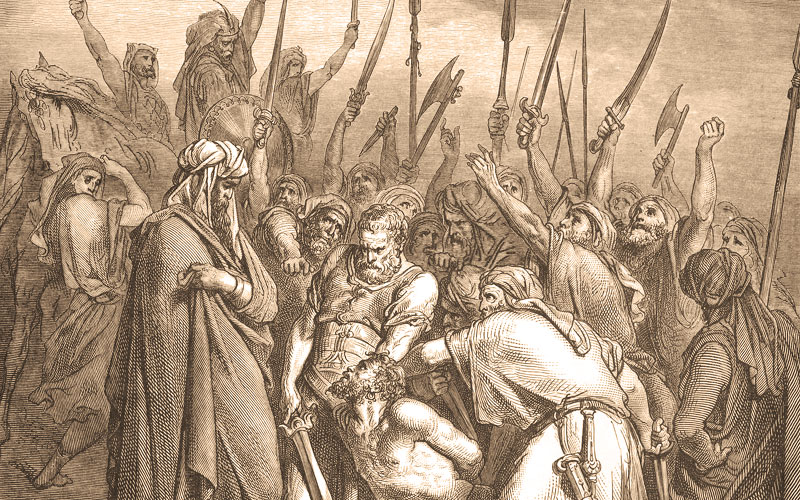
Death of King Agag

Now go and strike Amalek and utterly destroy all that he has, and do not spare him; but put to death both man and woman, child and infant, ox and sheep, camel and donkey” (1 Samuel 15:3).

The Lord gave Saul, king of Israel, a mission. While it may not have been an easy task, it was a simple one. It was not one that Saul could misunderstand. The Lord wanted the nation of Amalek to be punished and He sent Saul on a mission to do it. Again, this was a simple task: Destroy everything. Yet Saul’s actions in carrying out that task caused him to be rejected from being king (1 Samuel 15:26) and caused the Lord to regret even making him king (1 Samuel 15:35). Let us look at some lessons we can learn from Saul that relate to our obedience to God.
Continue Reading

Our Sins and His Cross

Cross

Sin separates man from God (Isaiah 59:2). Jesus came to bring back peace between man and God (Ephesians 2:13-16). To do this, He needed to do something to remedy the problem of sin. Peter wrote, “Christ also died for sins once for all” (1 Peter 3:18). Jesus’ death on the cross was God’s solution for sin. But how did this fix the problem? Some teach that our sins were placed upon Christ and then, in essence, “nailed to the cross.” Is this what happened? It is a familiar concept. But is it a Biblical idea?

One passage used to justify the idea that Jesus took on our sins and carried them to the cross is 2 Corinthians 5:21. “He made Him who knew no sin to be sin on our behalf, so that we might become the righteousness of God in Him.” What does it mean that Jesus was made “to be sin on our behalf”? Isolating this verse from its context and ignoring related passages, there are three possible interpretations:
Continue Reading

The Soul Who Sins Will Die

Ezekiel 18:4

God’s word teaches us that we are individually accountable before Him: “For we must all appear before the judgment seat of Christ, so that each one may be recompensed for his deeds in the body, according to what he has done, whether good or bad” (2 Corinthians 5:10). This passage shows us that judgment is certain. We “must” stand before Christ in judgment. This is not something that could happen but something that will happen. Reward or punishment will be meted out to “each one…according to what he has done.” When we stand before the judgment seat of Christ, we will stand there and be judged alone. We will not have any family, friends, or church to lean upon. We are accountable as individuals and will be judged as individuals.

An Old Testament passage that discusses this idea is Ezekiel 18. It is true that the law has changed and that we are no longer governed by the Old Testament (Hebrews 8:8-13). However, even though the law may be different, our responsibility before God in judgment is not. Therefore this passage presents helpful points for us to consider today. It also provides a good outline for our study.
Continue Reading

Of What Kind of Church Are You a Member?

Church building

In Matthew 16:18, Jesus promised to build His church. In Acts 2 we read about the establishment of that church. Throughout the book of Acts, we see how the church grew from its beginnings in Jerusalem on the day of Pentecost. The New Testament as a whole provides us with a picture of the church our Lord purchased with His blood (Acts 20:28). Several times, we read about a congregation being rebuked for problems that existed there. It can be profitable for us to consider the issues that affected these churches and compare them to the church where we are members. Every problem in every congregation in the New Testament will not be discussed in this article. But as we look at some of these, think about the congregation where you attend. Notice if there are things there that may need to be addressed as well.
Continue Reading

They Think It Strange

The Christian life is different from the life of one in the world. Paul told the Christians in Rome: “Do not be conformed to this world, but be transformed by the renewing of your mind” (Romans 12:2). While Paul was giving his defense before Agrippa, he used that opportunity to try and “persuade” the king “to become a Christian” (Acts 26:28). The statement by Agrippa showed that he realized that Paul was trying to convince him to become a Christian. The very fact that he had to be persuaded to become a Christian shows that living as a Christian requires one to be different from the world. In writing to Christians, Peter said that the ones who knew them before they were Christians would “think it strange” that they do not live in the same manner that they lived before (1 Peter 4:4). Why would they think it strange? What is it about the Christian life that is different from the world? We will notice a few points from the context surrounding 1 Peter 4:4.
Continue Reading