Thomas Campbell: “Where the Bible Speaks, We Speak; Where the Bible Is Silent, We Are Silent”

Thomas Campbell: "Where the Bible Speaks, We Speak"

Thomas Campbell (1763-1854) was one of the leading figures of the Restoration Movement that began in this country in the 19th century. He, along with men like Alexander Campbell (his son), Barton W. Stone, and Walter Scott, sought to unite believers by abandoning the creeds and denominations of men. In a speech delivered in 1808, Thomas Campbell set forth an idea that became a motto for the movement.
Continue Reading
Secularism

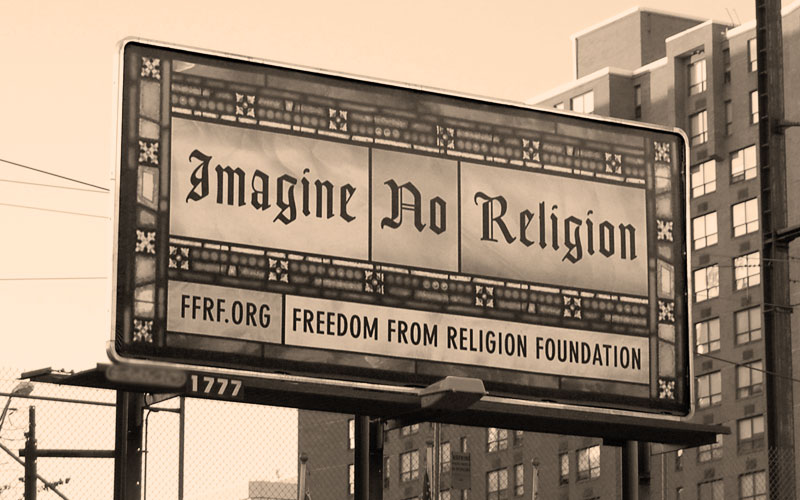
Imagine No Religion (billboard)

In his letter to the saints in Rome, Paul described the condition of the Gentile world as a whole: “And just as they did not see fit to acknowledge God any longer, God gave them over to a depraved mind, to do those things which are not proper” (Romans 1:28). They had rejected God in favor of their “gods.” Their “gods” – since they were a product of their own imagination – allowed them to do anything they wanted to do. As a result, they no longer felt hindered by God’s laws.

We live under similar conditions today. People in our society do not serve the same idols, but the similarity is in the sense that people see no reason to follow God’s laws. They are content to live without seeing any need for religion. This is secularism.

We live in an increasingly secular society. There are certain challenges that come with this. But why is a secular society a challenge for Christians? Let us consider secularism and the challenges it presents in this article.
Continue Reading

Christ’s Plan for His Church

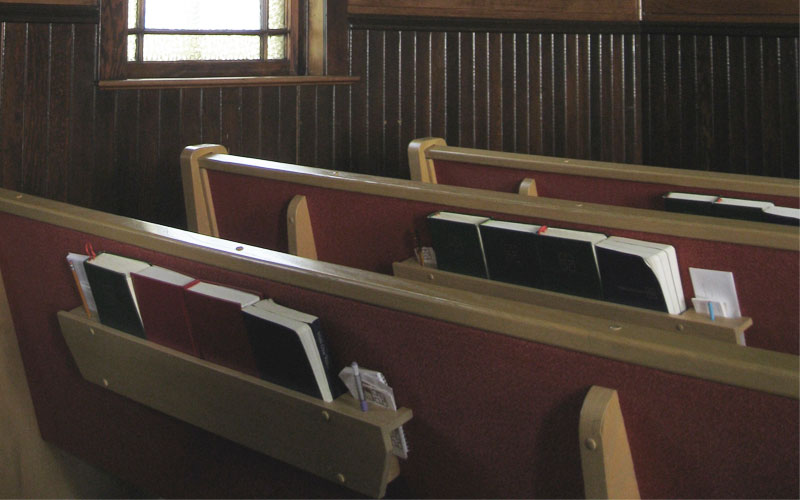
Pews

In writing to the brethren in Ephesus, Paul explained that “the manifold wisdom of God might now be made known through the church” (Ephesians 3:10). But when did the Lord decide that He would do this?

Some believe that Jesus “failed” to establish His kingdom when He came to earth so He established the church in its place until He returns a second time and will then set up His kingdom. However, the church was not established as an afterthought. It was not a backup plan. In fact, Jesus indicated that the church and the kingdom were the same, as He used the terms interchangeably (Matthew 16:18-19). Paul said that the Lord’s plan to make known God’s wisdom through the church was “in accordance with the eternal purpose which He carried out in Christ Jesus our Lord” (Ephesians 3:11).

Elsewhere in this letter, Paul described the church as the body and the bride of Christ (Ephesians 1:22-23; 5:23-24). This means that the church belongs to Him and is directed by Him. So what is Christ’s plan for His church? Let us consider a few points.
Continue Reading

Progressivism

Pointing - shadow

My son, fear the Lord and the king; do not associate with those who are given to change” (Proverbs 24:21).

The wise man warned about those who are “given to change.” These are ones who want change for the sake of change. Sometimes change is good and necessary, but other times it is not. However, change is inherently part of progressivism – the idea that we must continue to move forward and not remain as or where we were. In this article, we are going to discuss progressivism in religion – what it is and why it is dangerous.
Continue Reading

Always Learning, But Never Coming to Know the Truth

Bible study with coffee

Paul warned Timothy of those who were “always learning and never able to come to the knowledge of the truth” (2 Timothy 3:7). How is it possible for one to continue to progress in his learning but never come to know the truth of God’s word? There are three ways this can happen. Any one of these, or a combination of the three, will prevent someone from coming to know the truth.
Continue Reading

Diligently Seeking God

Man on a mountain

And without faith it is impossible to please Him, for he who comes to God must believe that He is and that He is a rewarder of those who seek Him” (Hebrews 11:6).

The Hebrew writer said that God will reward those who “diligently seek Him” (NKJV). Jesus promised that if we “seek,” we “will find” (Matthew 7:7). Is this a guarantee? Does the Bible teach that if we seek for God we can be assured of finding Him? Yes – provided we are seeking with the right attitude.

Paul told the ones gathered on Mars Hill that we can “seek God” and “find Him” because “He is not far from each one of us” (Acts 17:27). But how can He be found by those who are seeking for Him? In this article, we are going to consider how God made it so that He can be found by those who seek for Him.
Continue Reading

Top 5 Articles on Plain Bible Teaching in 2016

Top 5 Articles in 2016

As 2016 draws to a close, I wanted to take a look back at the articles that have generated the most interest this year. I’ve been doing this the past few years and it is always interesting to me to see what the most-read articles have been – usually not the ones I would have predicted. I’ve listed the “top 5” posts based on number of page views.

Top 5 new articles (posted in 2016):

  1. Church Membership (01.19.16)
  2. What Christians Need to Know About the Jehovah’s Witnesses (05.04.16)
  3. The Evils of Alcohol (02.09.16)
  4. What the Bible Says About Casting Lots (03.01.16)
  5. How Can People Know We Are Christians? (07.20.16)

Plus, here are the top 5 older articles (posted in 2015 or earlier) that continue to generate interest:

  1. Are the Jews Still God’s Chosen People Today? (02.11.11)
  2. The Older Women Must Teach the Young Women (05.02.12)
  3. What Happened After Saul’s Conversion (03.31.11)
  4. The Fields Are White for Harvest (08.09.09)
  5. A Short and Powerful Sermon (09.17.05)

Thanks to everyone for your continued interest in Plain Bible Teaching. If you are not yet on the mailing list to receive the free PBT Weekly Newsletter, be sure to subscribe to stay up to date on new content and more.