Why People Quit Church

It is a sad thing to see Christians fall away and forsake the assembly of the saints. We often wonder why someone would leave. An article posted today on the Christian Courier website looks at some of the reasons.

Click here to read the article: Why People Quit Church
Doctrinal Purity

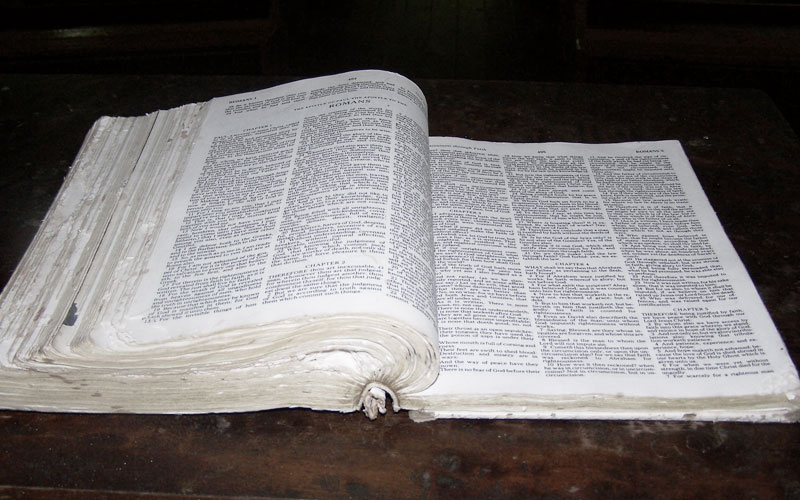
Open Bible

Doctrine, as many would define it, is not popular in religion today. Many believe that doctrine is what divides us. The denominations mostly leave matters of “doctrine” to the heads of their denomination. The preachers/pastors then can limit their message to topics like salvation, grace, love, social issues, etc. In the Lord’s church, some are de-emphasizing “doctrine” so they can focus more on the “gospel” (a faulty distinction that is not made in the New Testament). But doctrine simply means teaching. Many passages in the King James Version that use the word “doctrine” actually have the word “teaching” used instead in some of the newer translations. There is not a complicated definition of the word “doctrine.” That which is taught in the New Testament is doctrine.

The intent of this article is to show the importance of doctrinal purity. In the previous paragraph we noticed what doctrine is – the teaching contained in the New Testament. Purity means it is unchanged, uncorrupted, and complete. So when I speak of the need for doctrinal purity, I am referring to the desire to learn and believe all that is taught in the New Testament and only that which is taught in the New Testament. Many find this undesirable or impossible, but the word of God teaches that this must be our goal.
Continue Reading

The Restoration Plea

Cane Ridge Revival

In the first century, after the Lord’s church was established, there were no denominations like we have today. Of course, there were some who departed from the faith while still holding to a form of religion. A notable example is Diotrophes (3 John 9-11) who took control of a congregation and expelled those who wanted to follow the apostles’ doctrine. But generally, the churches in the first century could be accurately called “churches of Christ” (Romans 16:16) because they submitted to Christ’s authority and not to that of any man.

While the early church generally enjoyed unity by submitting to the authority of Christ alone, Paul warned of a movement that would change all of this. He wrote to the church at Thessalonica about “the apostasy” that was coming. He personified this great apostasy by calling it “the man of lawlessness” (2 Thessalonians 2:3). This “man of lawlessness” was described as one who “opposes and exalts himself above every so-called god or object of worship, so that he takes his seat in the temple of God, displaying himself as being God” (2 Thessalonians 2:4). This apostasy would be characterized by certain men exalting themselves among God’s people, claiming to speak for God and exercise authority over their brethren. It is called an apostasy because it would begin with some who were faithful Christians, but they would depart from the faith to follow their own doctrines and practices. This is exactly what denominationalism is. Denominationalism, beginning with the Catholic church, is the great apostasy.
Continue Reading

Living in View of Christ’s Return

Sun and Clouds over the Ocean

The Second Coming of Christ is a recurrent theme in both of Paul’s letters to the Thessalonians. It is discussed in some detail in both letters (1 Thessalonians 4:13-5:11; 2 Thessalonians 1:6-10) and is at least mentioned in every chapter but one (1 Thessalonians 1:10; 2:19; 3:13; 4:13-18; 5:1-11, 23; 2 Thessalonians 1:6-10; 2:1, 8). The Holy Spirit wanted these brethren to keep this event in their minds as they walked here on earth. These writings have been preserved for us today for the same reason. Remembering the reality of Christ’s return, what were the brethren in Thessalonica told to do? What they were told to do will apply to us as well. We are waiting for the Lord to return just as they were. Let us consider what we are to do as we wait.
Continue Reading

The Gospel of the Grace of God

Paul and the Ephesian Elders

On his way to Jerusalem, Paul stopped in Miletus to meet with the elders from the church in Ephesus (Acts 20:17ff). In this farewell address, Paul reminded them that the message he brought to them was “the gospel of the grace of God” (Acts 20:24). This was the message that Paul preached “everywhere in every church” (1 Corinthians 4:17). He preached the gospel to those who were already Christians (Romans 1:15) and to those who had not yet heard of Jesus (Romans 15:20). The gospel is the message that Jesus told His apostles to preach (Mark 16:15) and is the message that we must preach today (Galatians 1:8-9).
Continue Reading

Of What Kind of Church Are You a Member?

Church building

In Matthew 16:18, Jesus promised to build His church. In Acts 2 we read about the establishment of that church. Throughout the book of Acts, we see how the church grew from its beginnings in Jerusalem on the day of Pentecost. The New Testament as a whole provides us with a picture of the church our Lord purchased with His blood (Acts 20:28). Several times, we read about a congregation being rebuked for problems that existed there. It can be profitable for us to consider the issues that affected these churches and compare them to the church where we are members. Every problem in every congregation in the New Testament will not be discussed in this article. But as we look at some of these, think about the congregation where you attend. Notice if there are things there that may need to be addressed as well.
Continue Reading

A Famine in the Land

Drought

How much importance do we place in the word of God? Do we appreciate the seriousness of our responsibility to know God’s word? God said, “My people are destroyed for lack of knowledge” (Hosea 4:6). There are many passages we can read to show the importance of knowing God’s word. In this article we will notice one such passage that shows the importance of God’s word and the results of being without it.

‘Behold, days are coming,’ declares the Lord God, ‘when I will send a famine on the land, not a famine for bread or a thirst for water, but rather for hearing the words of the Lord. People will stagger from sea to sea and from the north even to the east; they will go to and fro to seek the word of the Lord, but they will not find it. In that day the beautiful virgins and the young men will faint from thirst. As for those who swear by the guilt of Samaria, who say, “As your god lives, O Dan,” and, “As the way of Beersheba lives,” they will fall and not rise again’” (Amos 8:11-14).

This passage begins with a parallel between the word of God and food in order to make the point that His word sustains us in our spiritual life in the same way that food sustains us in our physical life. This comparison is also made in the New Testament when the word of God is referred to as “milk” and “solid food,” or “meat” (1 Peter 2:2; Hebrews 5:12). Those passages teach that the word of God is designed to cause us to grow and mature as Christians. Other passages also show the importance of the word of God. Without the words of Christ, we cannot obtain eternal life (John 6:68). Without the gospel, we cannot be saved (Romans 1:16). In the same way that food nourishes us physically, God’s word nourishes us spiritually.
Continue Reading