Joshua Circumcised the People

Crossing the Jordan River

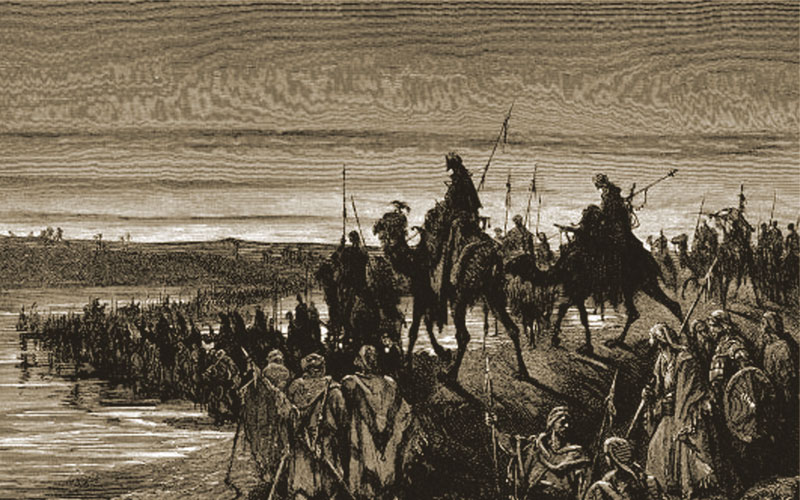
At that time the Lord said to Joshua, ‘Make for yourself flint knives and circumcise again the sons of Israel the second time.’ So Joshua made himself flint knives and circumcised the sons of Israel at Gibeath-haaraloth.

This is the reason why Joshua circumcised them: all the people who came out of Egypt who were males, all the men of war, died in the wilderness along the way after they came out of Egypt. For all the people who came out were circumcised, but all the people who were born in the wilderness along the way as they came out of Egypt had not been circumcised. For the sons of Israel walked forty years in the wilderness, until all the nation, that is, the men of war who came out of Egypt, perished because they did not listen to the voice of the Lord, to whom the Lord had sworn that He would not let them see the land which the Lord had sworn to their fathers to give us, a land flowing with milk and honey. Their children whom He raised up in their place, Joshua circumcised; for they were uncircumcised, because they had not circumcised them along the way.

Now when they had finished circumcising all the nation, they remained in their places in the camp until they were healed. Then the Lord said to Joshua, ‘Today I have rolled away the reproach of Egypt from you.’ So the name of that place is called Gilgal to this day” (Joshua 5:2-9).

After crossing the Jordan river into the land of Canaan (Joshua 3), but before conquering the first city (Joshua 6), the Lord commanded Joshua to circumcise the sons of Israel. It is important that we understand the reasons why this was done because their physical circumcision is parallel to our spiritual circumcision. Let us consider some lessons that we can learn from this account.
Continue Reading

“Lord, To Whom Shall We Go?”

Signpost

As a result of this many of His disciples withdrew and were not walking with Him anymore. So Jesus said to the twelve, ‘You do not want to go away also, do you?’ Simon Peter answered Him, ‘Lord, to whom shall we go? You have words of eternal life’” (John 6:66-68).

Public opinion can quickly change. This chapter in John’s gospel began with Jesus miraculously feeding five thousand people – and this number only included the men (John 6:1-13). As a result, the people concluded, “This is truly the Prophet who is to come into the world” (John 6:14). Believing this, they were ready “to come and take Him by force [and] make Him king” (John 6:15), even though this would require them to do battle against the powerful Roman army. But by the end of the chapter, all of them had left except for His twelve disciples (John 6:66-68).

Why did the crowd leave Jesus? There are at least two reasons for this:
Continue Reading

Not Ashamed of the Gospel

Romans 1:16

For I am not ashamed of the gospel, for it is the power of God for salvation to everyone who believes, to the Jew first and also to the Greek. For in it the righteousness of God is revealed from faith to faith; as it is written, ‘But the righteous man shall live by faith’” (Romans 1:16-17).

When Paul wrote to the saints in Rome, he said he was “not ashamed of the gospel” (Romans 1:16). Because of the confidence he had in Christ’s message, he was “eager to preach the gospel” (Romans 1:15) and do many other things in the cause of Christ.

We need to have the same confidence as Paul so that we can also say, “I am not ashamed of the gospel” (Romans 1:16). Can we say this? To answer that question, we need to consider what we would be willing to do with and for the gospel.
Continue Reading

Joshua’s Challenge to the People

Joshua 24:15

Most of us probably remember Joshua’s statement: “As for me and my house, we will serve the Lord” (Joshua 24:15). His mind was already settled. No matter what the rest of the people decided when he challenged them, “Choose for yourselves today whom you will serve,” he was determined to follow God.

But what did serving the Lord include? What was he challenging the people to do? Notice Joshua’s entire statement:
Continue Reading

A Letter to Little Children

1 John

Seven times in John’s first epistle, he referred to his audience as “little children.” He was not writing to actual “little children.” He was writing to Christians. But Christians are to be like “little children” – innocent and in need of guidance and protection. We are also “children of God” (1 John 3:1). In this article, I want us to consider the seven instructions that John gave to the “little children” and see what we should also do today.
Continue Reading

A Christian’s Ambition

Farming

Ambition is a trait that is seen as being desirable by many in the world. It is the attitude that drives one to continue progressing, advancing, and improving. Generally, it is necessary if one is to enjoy any degree of success or prosperity in life.

Christians are to be ambitious. But the focus of our ambitions will differ from that of the world. When Paul wrote to the saints in Thessalonica, he explained what their ambition was to be:

Make it your ambition to lead a quiet life and attend to your own business and work with your hands, just as we commanded you, so that you will behave properly toward outsiders and not be in any need” (1 Thessalonians 4:11-12).

Let us consider the points that Paul highlighted in this passage and see what our ambition should be as Christians.
Continue Reading

Wherever the Tree Falls

Fallen tree

If the clouds are full, they pour out rain upon the earth; and whether a tree falls toward the south or toward the north, wherever the tree falls, there it lies” (Ecclesiastes 11:3).

Man often takes pride in his perceived ability to control events in his life and achieve his goals. While it is certainly good to work to improve ourselves and change our lot in life for the better, we must also understand that there are many things in life that are simply out of our control.
Continue Reading