Thoughts on the Bible-Minded Cities Report

2015 Bible-Minded Cities

The Barna Group released a report on “Bible-Minded” cities. The report ranked the “Bible-mindedness” of individuals in the 100 largest media markets in the United States. According to the criteria of the Barna Group, an individual is “Bible-minded” based on two qualifications:

  1. They “report reading the Bible in a typical week.”
  2. They “strongly assert the Bible is accurate in the principles it teaches.”

It is interesting to read reports like this one. Regardless of how “Bible-minded” the cities are in which we live, there are some points we should consider.
Continue Reading

Why Being Non-Denominational Is Not Good Enough

Church steeple

In the past, more emphasis was placed upon one’s denominational affiliation. But for many today, this is less important. This shift in mindset has given rise to the number of “non-denominational” churches we see in the religious world.

For years, faithful brethren have rightly condemned denominationalism. So is the trend toward non-denominationalism a good thing? Maybe not. Why not? Simply being non-denominational is not good enough.

The church in Sardis was a dead church, though they had a reputation that they were alive. Jesus said to them, “I know your deeds, that you have a name that you are alive, but you are dead” (Revelation 3:1). This shows us that a church can seem to be good in the eyes of men, but in the eyes of the Lord, their status is completely different. In the eyes of many, “non-denominational” churches look appealing. But like the church in Sardis, many of these churches simply do not measure up to the Lord’s standard.
Continue Reading

Fear God and Keep His Commandments

Sunset by the sea

Solomon described conditions in life that are true from generation to generation. The sun rises and sets (Ecclesiastes 1:5); the wind blows and follows its circular course (Ecclesiastes 1:6); the rivers flow into the sea (Ecclesiastes 1:7); and “there is nothing new under the sun” (Ecclesiastes 1:9). In the end, his conclusion was that man’s purpose was to “fear God and keep His commandments” (Ecclesiastes 12:13).
Continue Reading

Happy Birthday, Jesus?

Nativity Scene

For most of us, the holidays are for spending time with family and enjoying the blessings that we have in this life. But for many in the religious world, the Christmas holiday is also a time for them to celebrate the birth of Jesus. Some even believe that Jesus was born on December 25th. Therefore, they observe Christmas (December 25th) as a religious holy day. However, there are two problems with this:
Continue Reading

How People Approach the Judgment

Clouds

And inasmuch as it is appointed for men to die once and after this comes judgment” (Hebrews 9:27).

Death is a reality for everyone. This fact is generally understood. However, many people do not recognize the reality or the seriousness of the other event mentioned by the Hebrew writer – judgment. Paul wrote, “For we must all appear before the judgment seat of Christ, so that each one may be recompensed for his deeds in the body, according to what he has done, whether good or bad” (2 Corinthians 5:10). Even though we will all face this judgment, not everyone approaches this appointment in the same way. Let us briefly consider five ways in which people approach the judgment.
Continue Reading

What Would Jesus Do?

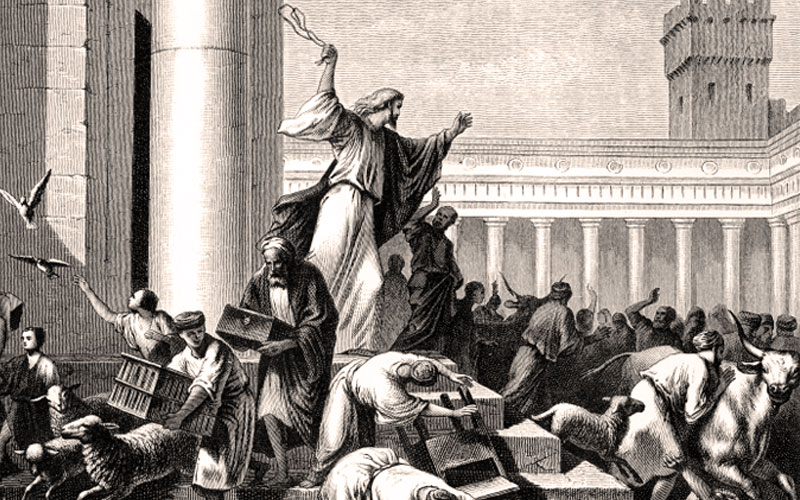
Jesus and the moneychangers

What would Jesus do? This is a question that many religious people ask themselves when they attempt to decide if a particular decision or activity is right. Their intentions might be good – trying to focus on Jesus and please Him. However, this question is the wrong question!

Why is this the wrong question? It is too subjective. It turns our responsibility into nothing more than what we think Jesus would do in a given situation. Instead of asking a subjective question like this (What would Jesus do?), let us consider some other questions to ask – questions for which we can find objective and definitive answers from the Scriptures.
Continue Reading

Traditionalism and Illiteracy

Matthew recorded a discussion that Jesus had with the Pharisees and scribes on the subject of traditions. The Pharisees and scribes questioned Jesus about His disciples breaking “the tradition of the elders” by not washing hands before eating bread (Matthew 15:1-2). Jesus responded by questioning them about another tradition in which they neglected to care for their parents in need, but justified themselves by claiming to have given the money that would have helped them to God (Matthew 15:4-5). Jesus said that keeping their tradition caused them to “transgress the commandment of God” (Matthew 15:3). They had “invalidated the word of God for the sake of [their] tradition” (Matthew 15:6).

The Pharisees and scribes were blinded by traditionalism. While there was nothing wrong with their tradition to wash hands before eating bread, their tradition blinded them to the fact that no sin was committed by one not washing his hands. The other tradition that Jesus cited led to a direct violation of God’s law. Yet their tradition blinded them to their sin of failing to honor their father and mother.

Jesus connected their traditionalism with the prophecy of Isaiah:

You hypocrites, rightly did Isaiah prophesy of you: ‘This people honors Me with their lips, but their heart is far away from Me. But in vain do they worship Me, teaching as doctrines the precepts of men’” (Matthew 15:7-9).

If we look at the context of Isaiah’s prophecy, we can see that Jesus likened their traditionalism to illiteracy.
Continue Reading