Road Trip (Part 3): The Road to Gaza

The Road to Gaza

On our next stop in this series, we are going to find a man who was going down the road to Gaza. Here we will learn about preaching Jesus.

But an angel of the Lord spoke to Philip saying, ‘Get up and go south to the road that descends from Jerusalem to Gaza.’ (This is a desert road.) So he got up and went; and there was an Ethiopian eunuch, a court official of Candace, queen of the Ethiopians, who was in charge of all her treasure; and he had come to Jerusalem to worship, and he was returning and sitting in his chariot, and was reading the prophet Isaiah. Then the Spirit said to Philip, ‘Go up and join this chariot.’ Philip ran up and heard him reading Isaiah the prophet, and said, ‘Do you understand what you are reading?’ And he said, ‘Well, how could I, unless someone guides me?’ And he invited Philip to come up and sit with him.

Now the passage of Scripture which he was reading was this: ‘He was led as a sheep to slaughter; and as a lamb before its shearer is silent, so He does not open His mouth. In humiliation His judgment was taken away; who will relate His generation? For His life is removed from the earth.’ The eunuch answered Philip and said, ‘Please tell me, of whom does the prophet say this? Of himself or of someone else?’ Then Philip opened his mouth, and beginning from this Scripture he preached Jesus to him.

As they went along the road they came to some water; and the eunuch said, ‘Look! Water! What prevents me from being baptized?’ And Philip said, ‘If you believe with all your heart, you may.’ And he answered and said, ‘I believe that Jesus Christ is the Son of God.’ And he ordered the chariot to stop; and they both went down into the water, Philip as well as the eunuch, and he baptized him. When they came up out of the water, the Spirit of the Lord snatched Philip away; and the eunuch no longer saw him, but went on his way rejoicing” (Acts 8:26-39).

This occurred at the time in which the disciples were “scattered” from Jerusalem due to persecution and “went about preaching the word” (Acts 8:4). Philip was among this number, but the Lord specifically directed him to go to this place. Let us notice some lessons from this.Continue Reading

Road Trip (Part 2): The Road to Emmaus

The Road to Emmaus

As we continue this series, let us notice two men who were traveling the road to Emmaus. As we go along with them, we will learn about recognizing Jesus.

And behold, two of them were going that very day to a village named Emmaus, which was about seven miles from Jerusalem. And they were talking with each other about all these things which had taken place. While they were talking and discussing, Jesus Himself approached and began traveling with them. But their eyes were prevented from recognizing Him. And He said to them, ‘What are these words that you are exchanging with one another as you are walking?’ And they stood still, looking sad. One of them, named Cleopas, answered and said to Him, ‘Are You the only one visiting Jerusalem and unaware of the things which have happened here in these days?’

And He said to them, ‘What things?’ And they said to Him, ‘The things about Jesus the Nazarene, who was a prophet mighty in deed and word in the sight of God and all the people, and how the chief priests and our rulers delivered Him to the sentence of death, and crucified Him. But we were hoping that it was He who was going to redeem Israel. Indeed, besides all this, it is the third day since these things happened. But also some women among us amazed us. When they were at the tomb early in the morning, and did not find His body, they came, saying that they had also seen a vision of angels who said that He was alive. Some of those who were with us went to the tomb and found it just exactly as the women also had said; but Him they did not see.’

And He said to them, ‘O foolish men and slow of heart to believe in all that the prophets have spoken! Was it not necessary for the Christ to suffer these things and to enter into His glory?’ Then beginning with Moses and with all the prophets, He explained to them the things concerning Himself in all the Scriptures. And they approached the village where they were going, and He acted as though He was going farther. But they urged Him, saying, ‘Stay with us, for it is getting toward evening, and the day is now nearly over.’ So He went in to stay with them.

When He had reclined at the table with them, He took the bread and blessed it, and breaking it, He began giving it to them. Then their eyes were opened and they recognized Him; and He vanished from their sight. They said to one another, ‘Were not our hearts burning within us while He was speaking to us on the road, while He was explaining the Scriptures to us?’ And they got up that very hour and returned to Jerusalem, and found gathered together the eleven and those who were with them, saying, ‘The Lord has really risen and has appeared to Simon.’ They began to relate their experiences on the road and how He was recognized by them in the breaking of bread” (Luke 24:13-35).

This occasion was one of the post-resurrection appearances of Jesus. Interestingly, even though these men were disciples, they did not recognize the Lord at first. Let us consider some points from this.Continue Reading

Studying the History of Fallible Religious Leaders

Restoration Movement Leaders

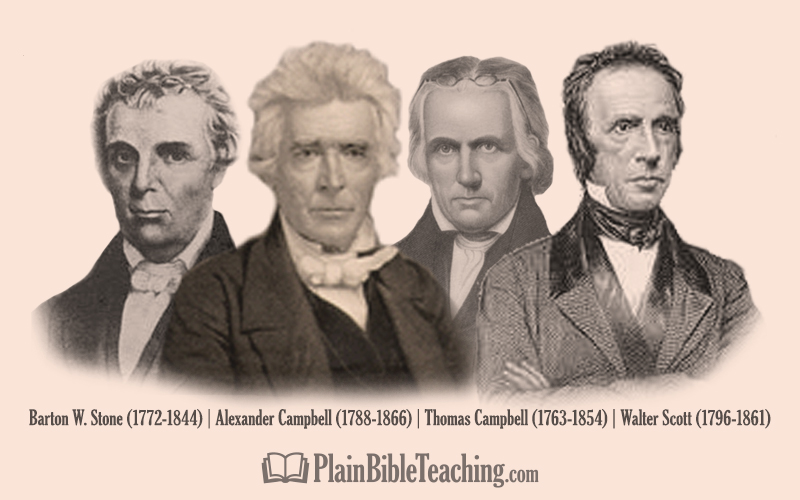
Besides studying the Bible, the topic I enjoy learning about the most is religious history – particularly the history of the Restoration Movement (sometimes called the Stone-Campbell Movement). This was a period in the 19th and early 20th centuries in the United States in which many were troubled by the divisions they saw in the religious world and endeavored to correct this by striving to simply go back to the Bible and follow it alone as their only rule of faith and practice.

Some of the more influential figures in this movement were Thomas and Alexander Campbell, Barton W. Stone, and Walter Scott. Usually when people think of this history today, these are the men who come to mind. As we begin to study this history, we learn of others who played a significant role in the direction of this movement – men like Moses Lard, Benjamin Franklin, Daniel Sommer, and David Lipscomb. Going deeper into the study of this history, we can learn about the contributions of others like David Purviance, Pardee Butler, Samuel Robert Cassius, and more – men who may have been largely forgotten, but can provide us with some valuable lessons.*Continue Reading

Road Trip (Part 1): The Road to Jericho

To begin this series, we are going to visit one who was traveling the road to Jericho. As we make this journey, we will learn about loving our neighbor.

Jesus replied and said, ‘A man was going down from Jerusalem to Jericho, and fell among robbers, and they stripped him and beat him, and went away leaving him half dead. And by chance a priest was going down on that road, and when he saw him, he passed by on the other side. Likewise a Levite also, when he came to the place and saw him, passed by on the other side.

‘But a Samaritan, who was on a journey, came upon him; and when he saw him, he felt compassion, and came to him and bandaged up his wounds, pouring oil and wine on them; and he put him on his own beast, and brought him to an inn and took care of him. On the next day he took out two denarii and gave them to the innkeeper and said, “Take care of him; and whatever more you spend, when I return I will repay you.”

‘Which of these three do you think proved to be a neighbor to the man who fell into the robbers’ hands?’ And he said, ‘The one who showed mercy toward him.’ Then Jesus said to him, ‘Go and do the same’” (Luke 10:30-37).

This is one of the more well-known parables of Jesus. Most people have at least heard of the “good Samaritan.” Let us consider some lessons from it.Continue Reading

Book Review: Growing Up in the 2020s

Growing Up in the 2020s (cover)There have always been challenges for young people, especially for those who are trying to be faithful to the Lord. However, it seems like the present may be especially difficult. Not only are young people needing to overcome the temptations prevalent in the culture, but those who are trying to help them – parents, grandparents, Bible teachers, etc. – may not know quite how to address certain topics because they truly seem unique to our modern society.


Growing Up in the 2020s: A Bible Study Workbook for Teens by Trevor Brailey is a workbook that is designed to help young people navigate the current cultural landscape. In addition to being a preacher, the author also works as a substitute teacher, giving him additional insight about what teenagers are facing.Continue Reading

Road Trip: Introduction

Road Trip

When we hear the phrase “road trip,” we probably have a certain picture that comes to mind – one that involves an escape from everyday life, traveling to a new place, and encountering all sorts of exciting unknowns along the way. In other words, it is an adventure. Many of us enjoy these excursions and will be looking forward to the next one.

However, most of the traveling that we do pertains to our regular responsibilities in life. We will go to work, go to worship services, go to visit family and friends, go to the grocery store, and so on. Our lives are filled with routine trips like these. And while we do not think of them in the same way as we do a vacation, there are times when we encounter the unexpected on these regular outings.

Ever since mankind has been scattered over the earth, there have been travelers going from one place to another. Occasionally these are purely for enjoyment like the vacation-type of “road trip” that we might imagine when we hear that phrase; but most journeys were for mundane reasons. Yet sometimes it is during the otherwise unremarkable affairs of life that one experiences some significant event or learns some vital lesson.Continue Reading

New Every Morning

Sunrise

This I recall to my mind, therefore I have hope. The Lord’s lovingkindnesses indeed never cease, for His compassions never fail. They are new every morning; great is Your faithfulness. ‘The Lord is my portion,’ says my soul, ‘Therefore I have hope in Him’” (Lamentations 3:21-24).

We sometimes hear it said that each day is a gift. This is certainly true, yet we need to know why this is true. It is about more than the simple fact that we are still alive. Each day is a gift because of God and what He provides for us each day.

In the passage above, Jeremiah reflected upon the goodness of God even as he and the nation were going through severe suffering (hence the name of the book Lamentations). There was still evidence of God’s care for them and a reason to have hope if they would focus on Him more than their present troubles.Continue Reading