Put On the Full Armor of God

We are engaged in a war for the cause of Christ. This is not a physical war; instead, it is spiritual (2 Corinthians 10:4). It is a battle for the souls of men. In order to help us in this fight, God has given us the armor that we must put on so that we will be able to “stand firm against the schemes of the devil” (Ephesians 6:11). Let us notice the armor with which the Lord has equipped us.
Continue Reading

Emphasizing Jesus Christ

Crosses

Paul told the saints in Corinth, “For I determined to know nothing among you except Jesus Christ, and Him crucified” (1 Corinthians 2:2). Why did Paul place such an emphasis on teaching Jesus? He explained: “So that your faith would not rest on the wisdom of men, but on the power of God” (1 Corinthians 2:5).

The Corinthians had a problem of following after men. This resulted in division as some were saying, “‘I am of Paul,’ and ‘I of Apollos,’ and ‘I of Cephas,’ and ‘I of Christ’” (1 Corinthians 1:12). Paul later explained that when they claimed loyalty to these men, they were carnally minded and immature (1 Corinthians 3:1-4).

The inspired apostle sought to correct this thinking so that they would focus on following Christ and not men. This is the first problem he addressed in his letter (1 Corinthians 1:10-17). But notice how he subtly made this point before he explicitly stated it.
Continue Reading

The Gospel of the Grace of God

Paul and the Ephesian Elders

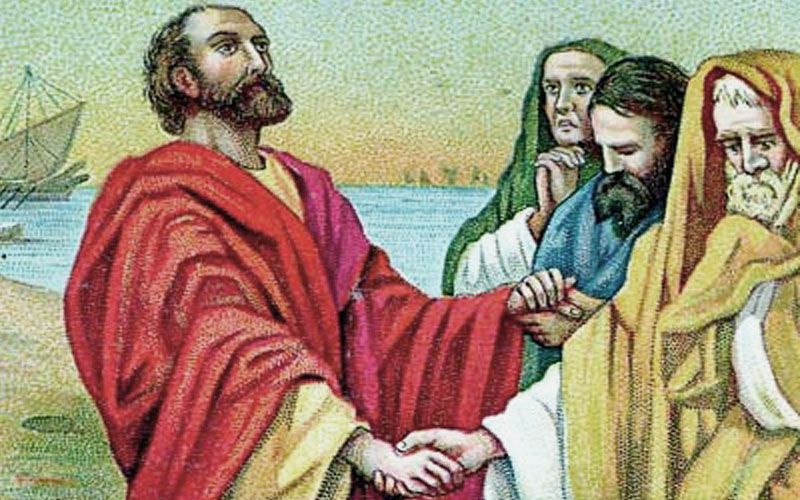
On his way to Jerusalem, Paul stopped in Miletus to meet with the elders from the church in Ephesus (Acts 20:17ff). In this farewell address, Paul reminded them that the message he brought to them was “the gospel of the grace of God” (Acts 20:24). This was the message that Paul preached “everywhere in every church” (1 Corinthians 4:17). He preached the gospel to those who were already Christians (Romans 1:15) and to those who had not yet heard of Jesus (Romans 15:20). The gospel is the message that Jesus told His apostles to preach (Mark 16:15) and is the message that we must preach today (Galatians 1:8-9).
Continue Reading

Of First Importance

For I delivered to you as of first importance what I also received, that Christ died for our sins according to the Scriptures, and that He was buried, and that He was raised on the third day according to the Scriptures” (1 Corinthians 15:3-4).

Paul told the Corinthians that he had and was presently preaching the gospel to them (1 Corinthians 15:1). The reason why it was important is because the gospel brings salvation (1 Corinthians 15:2). It is “the power of God for salvation” (Romans 1:16). In the preaching of the gospel, that which is “of first importance” is the death, burial, and resurrection of Christ.
Continue Reading

Constants in a Changing World

River

This world is full of constant change. Many things come and go, whether they are people, cultures, governments, trends, or fashions. Yet the writer of Ecclesiastes noted, “There is nothing new under the sun” (Ecclesiastes 1:9). The changes we see are just perpetual cycles that exist in this world. But in the midst of the changes we face in this life, there are certain fundamental truths that will always remain constant.
Continue Reading

Confidence in the Word of God

As the world moves further away from the principles of the word of God, and many in religion are seeking guidance and direction from other sources, we need to be reminded of the power of the word of God. The Hebrew writer said, “The word of God is living and active and sharper than any two-edged sword, and piercing as far as the division of soul and spirit, of both joints and marrow, and is able to judge the thoughts and intentions of the heart” (Hebrews 4:12). In writing to the saints in Rome, Paul spoke of his confidence in the gospel: “For I am not ashamed of the gospel, for it is the power of God for salvation to everyone who believes, to the Jew first and also to the Greek” (Romans 1:16).

In spite of these reminders of the power in God’s word, many view simple Bible study and plain Bible teaching as being foolish. Paul spoke of this attitude in his letter to the church in Corinth: “For the word of the cross is foolishness to those who are perishing, but to us who are being saved it is the power of God” (1 Corinthians 1:18).
Continue Reading

Quenching the Spirit

Near the close of Paul’s first epistle to Thessalonica, he gave several brief exhortations. One of these was the instruction, “Do not quench the Spirit” (1 Thessalonians 5:19). What does it mean to “quench the Spirit”? The Greek word that is translated quench means to extinguish, or put out. This makes us think of extinguishing a fire. The word of God is compared to a fire elsewhere as Jeremiah described it as “a burning fire shut up in my bones” (Jeremiah 20:9).

We should also remember that the gospel is “the power of God for salvation” (Romans 1:16). To “quench the Spirit” is to remove the power from the gospel. After all, the revealed word is the product of the Spirit (2 Timothy 3:16; 1 Corinthians 2:10-13; John 15:26-27). The gospel is designed to convert the lost and edify the saved. Quenching the Spirit prevents these things and, ultimately, will cause us to forfeit our salvation. So we should look at how we are to preach so as not to quench the Spirit. How do we “quench the Spirit”?
Continue Reading